

Destination
The Galápagos Islands
The only place on earth where the animals ignore you. Nineteen islands, three of them inhabited, and a set of rules strict enough that it still works after 330,000 visitors a year.
Short answer
The Galápagos is a province of Ecuador about 900 km off the Pacific coast, where 97 % of the land is national park and the wildlife has no evolved fear of people. You reach it on a two-hour flight from Quito or Guayaquil, pay US$220 per adult in mandatory fees on top of any tour, and choose between a cruise (which reaches the remote outer islands) and island hopping (hotels on Santa Cruz, Isabela and San Cristóbal). Five days is the practical minimum; seven to eight is where it stops feeling rushed. There is no bad season — only different wildlife.
Quick facts
- Where
- A province of Ecuador, roughly 900 km off the Pacific coast
- Protected
- 97 % of the land area is national park
- Visitors
- ≈ 330,000 per year (2024 record: 329,475)
- Mandatory fees
- US$200 park fee + US$20 transit card, per adult
- Getting there
- 2 h flight from Quito or Guayaquil to Baltra or San Cristóbal
- Minimum sensible stay
- 5 days · 7–8 days to do it properly
Why the wildlife does not run away
The Galápagos sit on the equator where three ocean currents collide — the cold Humboldt from the south, the Panama current from the north, and the deep Cromwell upwelling from the west. That collision is why you can snorkel with penguins in the tropics, and why marine iguanas exist at all.
It is also why the animals are unafraid. These islands never had large land predators, so nothing evolved a flight response to a large mammal walking towards it. A blue-footed booby will nest on the path and expect you to walk around it. That is the entire experience, and no zoo, reserve or documentary substitutes for it.
The three inhabited islands, and what each is for
Santa Cruz — the hub
Puerto Ayora is the largest town in the archipelago and the practical centre of everything: the Charles Darwin Research Station, the widest choice of day boats, the highland tortoise reserves where you walk among wild giant tortoises, and the lava tunnels. If you only base on one island, it is this one. It is also the least beautiful of the three, and the busiest.
Isabela — the one people wish they had given more days
The largest island, formed from six volcanoes, and still the quietest of the inhabited three. Puerto Villamil is a sand-street town on a long white beach. From here you reach Sierra Negra — one of the largest volcanic calderas on the planet — and Los Túneles, a maze of collapsed lava arches that is the single best snorkelling site reachable without a cruise: sea turtles, seahorses, white-tipped sharks, in clear shallow water.
San Cristóbal — where the sea lions took the town
The provincial capital, and the easiest arrival: the airport is a five-minute drive from the hotels rather than the two-hour transfer you face from Baltra. Sea lions occupy the municipal beach, the benches and occasionally the boats. Kicker Rock, offshore, is one of the best snorkelling and diving sites in the islands.
Cruise or land? Decide this before anything else
This decision determines your budget, your dates and what you will actually see, and most operators push you toward whichever they have inventory in.
Short version: a cruise sails overnight, so it reaches Genovesa, Española, Fernandina and Bartolomé — outer islands that a day boat cannot reach and return from. Island hopping keeps you on land, which means a hotel bed, restaurant choice, no seasickness and a materially lower price, but limits you to the three inhabited islands and their day-trip radius.
We wrote the full comparison, including the seasickness question and why boat size matters more than boat luxury: Galápagos cruise vs island hopping →
When to go, by what you want to see
| Season | Conditions | What it is best for |
|---|---|---|
| December – May Warm / wet season | Air 25–30 °C, water 21–25 °C, calm seas, short heavy showers, best underwater visibility | Snorkelling and first-time visitors. Green sea turtles nest. Land birds breed and the vegetation is green. Calmest crossings — the season to pick if you are worried about seasickness. |
| June – November Cool / dry season | Air 19–26 °C, water 18–22 °C, rougher seas, overcast garúa mist | Marine life. The Humboldt current brings nutrients: more penguins, sea lion pups, whale sharks in the north (roughly July–November), albatross on Española (April–December). Wetsuits genuinely needed. |
Mid-June to early September and mid-December to mid-January are when the good boats and the island flights sell out. Four to six months ahead is normal for those windows. Outside them, six to eight weeks is usually enough.
What it costs, honestly
Two charges are fixed and identical for everyone, whatever you book: the US$200 National Park entrance fee per adult, paid in cash on arrival, and the US$20 transit control card, registered online before your flight. Add the mainland–islands return flight, typically US$400–600 depending on season and lead time. Only then does the tour price start.
Full breakdown, including what gets confiscated at biosecurity and what arrival day actually looks like: Galápagos fees, permits and arrival →
How we run Galápagos trips
- National Park–licensed naturalists on every excursion. A legal requirement in the islands, and routinely dodged by the cheapest operators.
- We tell you the fees before you book, not at the airport. Every quote we send states the US$220 separately and in bold.
- We will talk you out of a cruise if you have told us you get seasick. We would rather book the lower-value trip you enjoy.
- We build the hybrid — a short cruise for the outer islands with land nights either side — which needs a ground operator to assemble and is why resellers rarely offer it.
The setting
What the islands actually look like
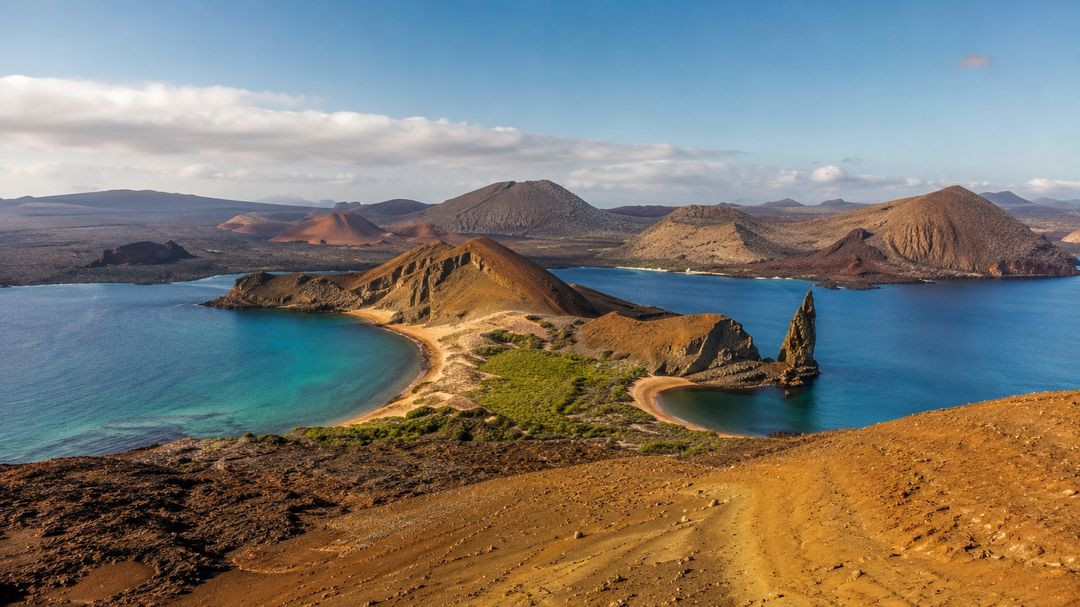
Five landscapes you will stand in. Most of the archipelago is not beach — it is black lava, dry scrub and cactus, and the water is colder than the latitude suggests.
-
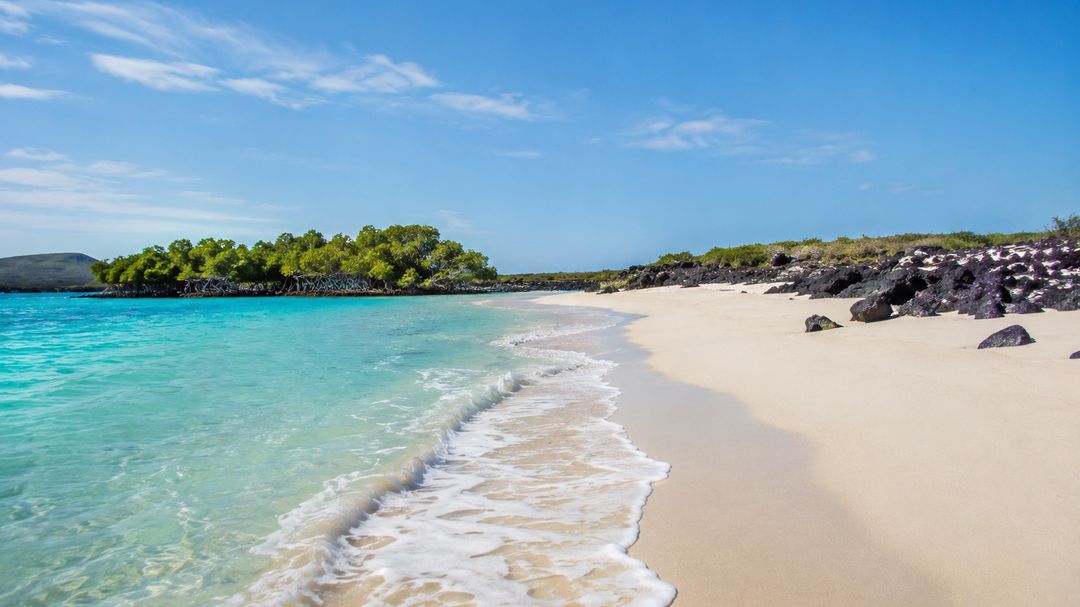
White sand and turquoise shallows on a north-shore beach -
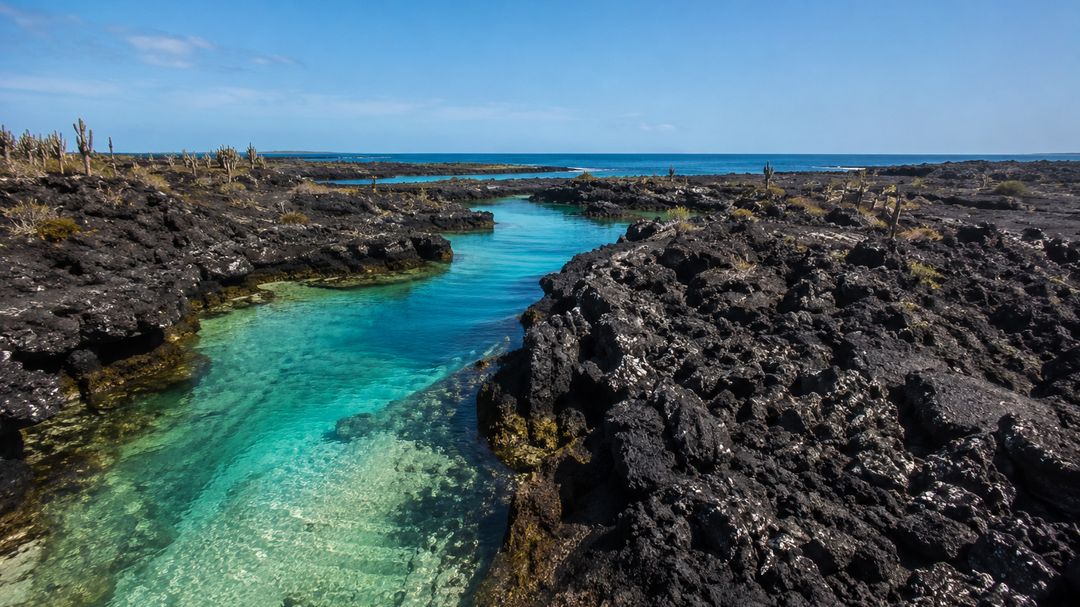
Channels of clear water cut through black lava — the calm snorkelling you reach without a cruise -
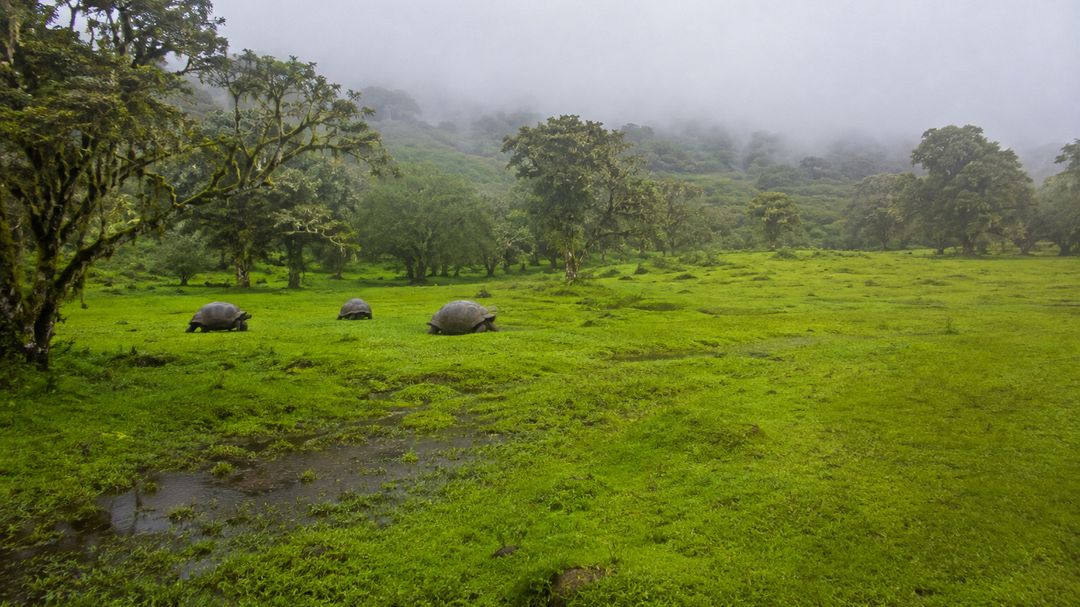
The wet highlands: green pasture, mist, and free-roaming giant tortoises -
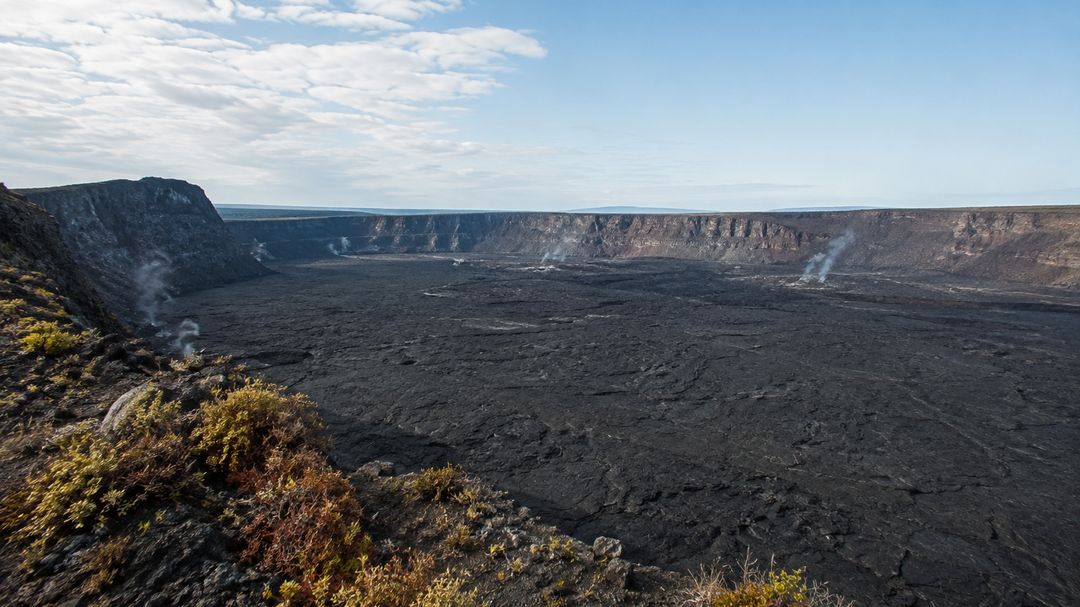
A caldera floor of recent lava, several kilometres across -
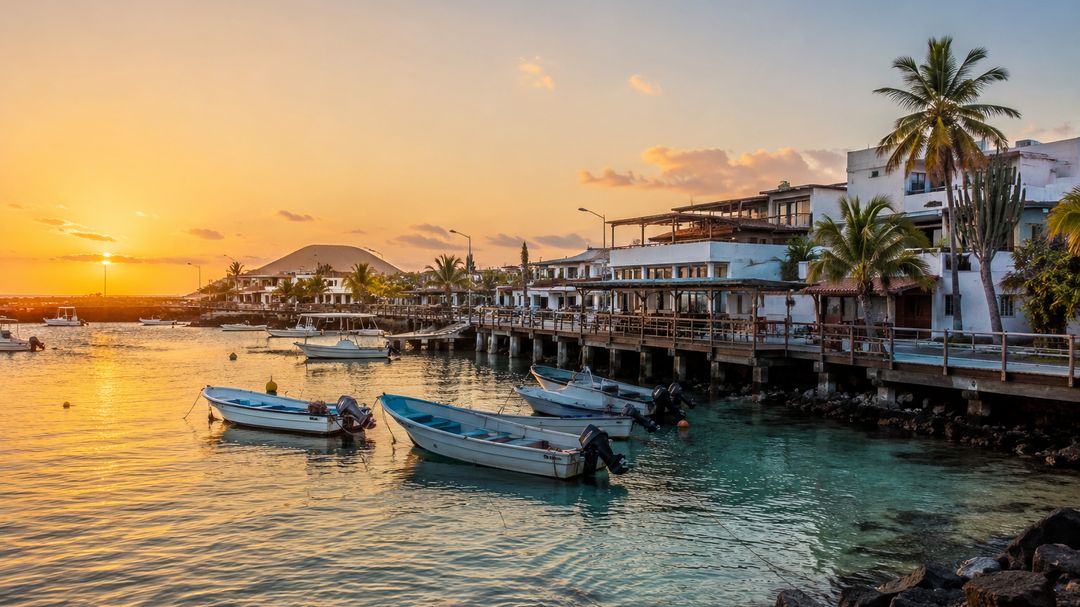
The harbour at dusk in one of the four inhabited settlements


These five are illustrations, not photographs of a named site. We do not yet have our own pictures of the islands, and we would rather say that than pass off someone else's. The animals on the species pages are illustrated the same way. Everything factual here — fees, dates, sea temperatures, distances — is sourced and linked.
Straight answers
The Galápagos Islands — questions people ask
How many days do you need in the Galápagos?
Five days is the practical floor, because your arrival and departure days are largely eaten by transfers and the park fee queue. Seven to eight days is where an itinerary stops feeling rushed and you get a genuine third island or a proper diving day.
What is the best time to visit the Galápagos?
There is no bad month — this is one of the few destinations where that is literally true. December to May is warm and wet with calm seas, the best water visibility and the most active land birds. June to November is cooler and drier with rougher water, stronger currents and the richest marine life: whale sharks in the north, more penguins and sea lion pups. Choose by what you want to see, not by weather.
Do you need a guide in the Galápagos?
For most of the archipelago, yes, and it is a legal requirement, not an upsell. Around 97 % of the land area is national park, and the great majority of visitor sites may only be entered accompanied by a naturalist licensed by the Galápagos National Park. Only a handful of sites near the towns can be visited independently.
Can you swim with sea lions and sharks in the Galápagos?
Yes, and you almost certainly will. Galápagos wildlife has no evolved fear of humans, so sea lions routinely play around snorkellers and white-tipped reef sharks rest in the shallows at sites like Las Tintoreras. The rule is that you may not touch or approach within two metres — but they were never told that, and they approach you.
Is the Galápagos worth the money?
It is expensive and it does not pretend otherwise: US$220 in mandatory fees, a flight from the mainland, and a tour on top. What you get is a place where the animals do not run away, which does not exist anywhere else on earth at this scale. Nearly 330,000 people made that trade in 2024. If you want a cheap beach holiday, it is the wrong destination; if you want the wildlife, there is no substitute.
Which Galápagos island should I stay on?
Santa Cruz (Puerto Ayora) has the most services, the widest day-trip choice and the Charles Darwin Station — it is the default base. Isabela (Puerto Villamil) is quieter, more beautiful and has Sierra Negra and Los Túneles. San Cristóbal is where sea lions occupy the town beach and the airport is a five-minute drive from your hotel. Most good land itineraries use two of the three.
Read before you book
The parts that decide the trip
The wildlife, species by species
What you will meet, and the exact islands and sites where you see it. Our own field guide.
Read →Darwin and the finches: what actually happened
Almost everything published about this is wrong on one point. The real sequence is stranger, and still running today.
Read →Snorkelling: the sites, and who each suits
What most visitors actually do. From a free walk-in pool to open ocean with current — and the wetsuit question.
Read →Turtles and tortoises are not the same animal
One lives on land and cannot swim. Where you see each, and why the confusion costs people a day.
Read →Diving: sites, seasons and who it suits
Hammerheads and whale sharks in cold moving water. Which sites need what certification, and why it is not a reef holiday.
Read →The islands, one at a time
Only four are inhabited and they are not interchangeable. What each is for, and what it costs you in boat time.
Read →The visitor sites, one by one
An itinerary is a list of names. This is what those names are: how you land, what goes wrong, and who each one is not for.
Read →How to get to the Galápagos
Flights only, and only from mainland Ecuador. Which airport, which city, and the 90 minutes after landing.
Read →Best time to visit, month by month
Two seasons and what each is good at, sea temperature by month, and the one window we steer people away from.
Read →When to go
Two Galápagos seasons and what each one is good at, the Andes rule, whale dates, and the months to avoid.
Read →The Galápagos price index
Eight days added up line by line. Our own per-day rates, the flight nobody quotes, and why the tour price is only two thirds of the total.
Read →Cruise or island hopping?
A cruise buys access to outer islands. Island hopping buys flexibility and a hotel bed. Which one your trip actually needs.
Read →Fees, permits and arrival day
The US$220 per adult that no tour price includes, plus the insurance question sources disagree on.
Read →Is Ecuador safe?
Galápagos is its own province, 900 km offshore. Here is why that matters — and the Guayaquil transit exception.
Read →Let's build this around your dates.
Tell us what you want to see and a planner in Cuenca will put together a routing that works — with real dates, real availability and the fees shown separately.
Plan your trip