

Charles Darwin Research Station, Santa Cruz
Short answer
The Charles Darwin Research Station sits at the edge of Puerto Ayora on Santa Cruz. It is a working science and breeding facility, not a zoo: corrals of juvenile tortoises being raised to a size predators cannot take, hatchling pens, and the preserved body of Lonesome George on display. It is walkable from town and free.
On this page — 7 sections
Lonesome George died in 2012 as the last Pinta Island tortoise, and with him a species ended. He is here, preserved, in a climate-controlled room. Nothing else in the islands makes the stakes as plain.
Charles Darwin Research Station at a glance
| Island | Santa Cruz, edge of Puerto Ayora |
|---|---|
| Guide | Not required |
| Cost | Free to enter |
| Access | A walk from the centre of Puerto Ayora |
| What it is | A working breeding and research centre |
| Time needed | An hour, more if you read everything |
- 1
Santa Cruz — Charles Darwin Research Station
The Charles Darwin Research Station sits at the edge of Puerto Ayora on Santa Cruz. It is a working science and breeding facility, not a zoo: corrals of juvenile tortoises being raised to a size predators cannot take, hatchling pens, and the preserved body of Lonesome George on display. It is walkable from town and free.
Photographs
Charles Darwin Research Station, photographed on our own trips
Our own photographs, not stock. Each caption says exactly where and when it was taken.
-
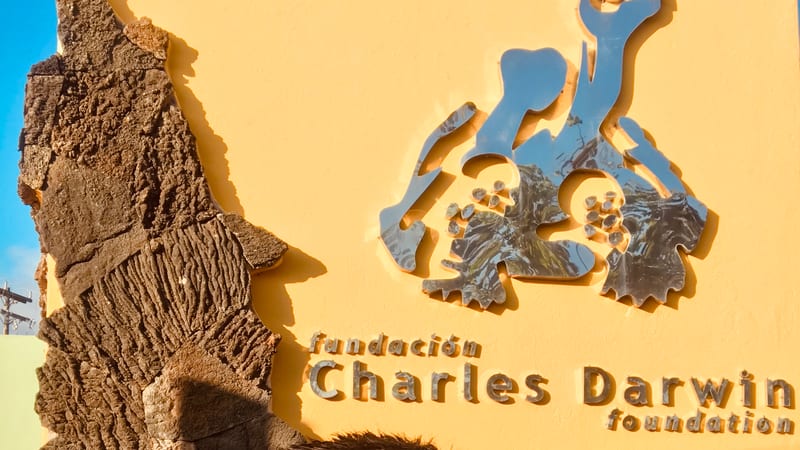
The entrance sign, with the archipelago in relief beside it Charles Darwin Research Station, Santa Cruz · January 2019

How you get there
- On foot from Puerto Ayora
- Along the seafront to the eastern end of town, then a short walk through cactus. Easy, and there is no reason to take a taxi.
It sits on Santa Cruz, so how you reach the island decides how you reach this.
What you actually see
The rearing corrals
Tortoises graded by age, from hatchlings the size of a hand up to juveniles ready for release. They are held until their shells are hard enough that rats cannot take them.
Lonesome George
The last Pinta Island tortoise, preserved and displayed in his own room. He is smaller than people expect and the room is quiet.
The land iguana enclosure
Part of the programme that has repopulated islands where they had been wiped out. Less visited than the tortoises and more interesting than it looks.
What goes wrong
We run these trips, so we know what people complain about afterwards. Better to read it here than find out on the day.
- People expect a zoo
- It is a working facility. The signage is scientific, the enclosures are functional, and there is no show. Visitors who came for spectacle leave flat.
- It is hot and shadeless in the middle of the day
- The walk out and the corrals are both in the open. Early morning.
- The wild tortoises are elsewhere
- If you want to see them free-ranging rather than in a pen, that is the highlands, not here. Do both — they are different experiences.
Who this is not for
Saying this costs us bookings and saves the trip. If any of these is you, tell us and we will build the day differently.
- Anyone hoping for a wildlife spectacle. This is conservation infrastructure.
- Visitors who only want to see tortoises in the wild — go to the highlands instead.
- People short on time in Puerto Ayora who have not yet seen Tortuga Bay.
What lives here
- Galápagos giant tortoise — Hatchlings and juveniles from several island populations.
- Galápagos land iguana — In the breeding enclosure.
- Darwin’s finches — Wild, all over the grounds, and easy to compare side by side.
Nearby
The Santa Cruz highlands
Santa Cruz
What it is →Tortuga Bay
Santa Cruz
What it is →Las Grietas
Santa Cruz
What it is →Black Turtle Cove
Santa Cruz
What it is →Las Bachas
Santa Cruz
What it is →El Garrapatero
Santa Cruz
What it is →Every visitor site we have written up → · Santa Cruz, the whole island →
Questions people also ask
Is the Charles Darwin Research Station free?
Yes, entry is free and no guide is required. It is a working research station rather than a paid attraction.
Can you see Lonesome George?
Yes. The last Pinta Island tortoise, who died in 2012, is preserved and on display in a dedicated room at the station.
Is it better than seeing tortoises in the highlands?
It is different. The station shows the breeding programme and the young animals; the highlands show wild adults grazing free. Most people do both.
Sources
Every figure on this page comes from one of these. If one of them changes and we have not caught up, tell us and we will fix it the same day.
Planning this trip yourself?
Send us the dates and what you actually want to see. A planner in Cuenca reads it and replies within one business day — not a template, and not a bot.
Plan your trip