

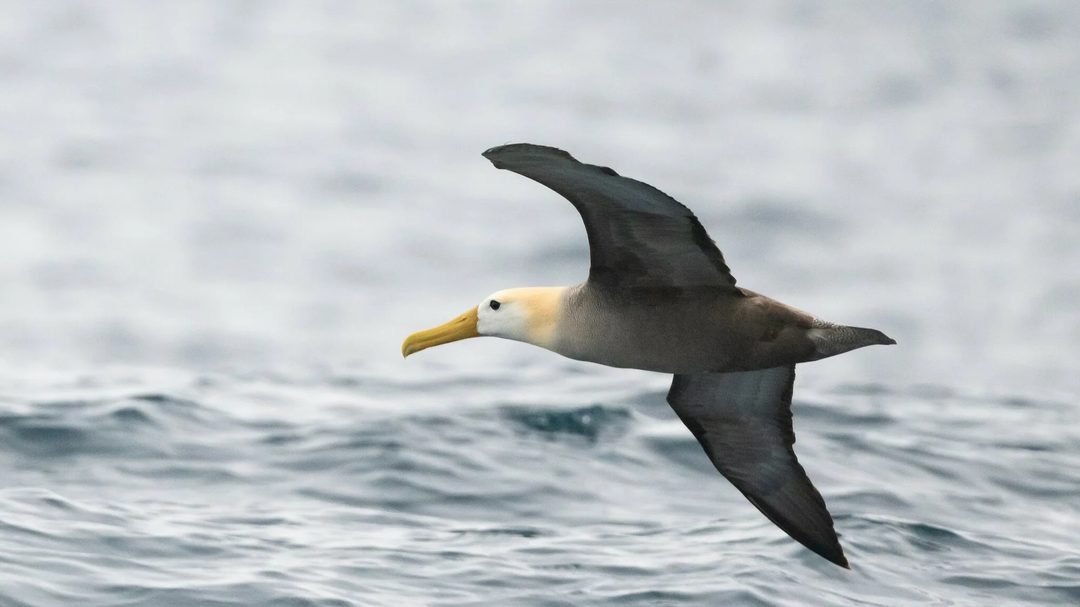
Galápagos wildlife · Bird · Endemic
The waved albatross
Phoebastria irrorata · Diomedeidae
Photo: Adam Jackson · iNaturalist · CC0 1.0
Short answer
The waved albatross nests on one island on Earth: Española, in the Galápagos. Around 12,000 breeding pairs arrive there between roughly April and December, perform one of the most elaborate courtship displays of any bird, raise a single chick and leave. For the rest of the year they are over open ocean off Peru and Ecuador. It is Critically Endangered, and it is the largest bird in the archipelago.
Actual size
wingspan, adult.
- Wingspan
- 2.5 m
- Weight
- 3–4 kg
- Lifespan
- 30–45 years
They build no nest at all. The egg is laid on bare ground and the parents shuffle it around as they take turns incubating — sometimes fifty metres from where it started. A significant number are simply lost down cracks in the lava.
Where you actually see one
This is the part a general encyclopedia cannot tell you: not where the species occurs, but which sites you can stand on, and what each one is like.
- 1
The colony, the courtship dances, and the cliff edge they use as a runway. April to December only.
- 2
Birds in the air offshore rather than a colony on the ground.
When to go for this one
April to December, and outside that window the island has none — they are thousands of kilometres away over the Humboldt current. Courtship peaks from late April through June; chicks are visible from around August. If the albatross is your reason for a cruise, check the month before you book anything else.
The archipelago has two seasons and they are good at different things — we break both down here, month by month.
How to tell it apart
- Enormous — a 2.5 m wingspan, twice the width of anything else in the islands.
- Creamy white head and neck, chocolate-brown body, and fine wavy barring on the breast that gives the species its name.
- A long, heavy, bright yellow bill.
- On the ground it walks with a rolling, ungainly gait. In the air it barely flaps.
What it does, and why
- The courtship dance is a sequence: bill circling, sky-pointing, a rapid clacking of beaks like a wooden rattle. Pairs perform it for days, and they mate for life.
- They build no nest. The single egg is simply laid on the ground and shuffled about — a pair may move it fifty metres over the incubation period, and eggs are regularly lost this way.
- They cannot take off from flat ground with ease. At Punta Suárez they walk to a cliff edge and drop off it to get airborne.
- A chick takes around 167 days to fledge, one of the longest of any seabird.
Why people miss it, and who it is not for
This is the part we can write and an encyclopedia cannot: what actually goes wrong when someone comes looking for this animal. It is from running these islands, not from a field guide.
The single biggest mistake is the month
From January to March there is not one bird on Española. Visitors book a southern cruise in February having seen the courtship dance online and arrive to an empty headland. Check the month before you book anything else.
It is one island, and it needs a cruise
There is no day trip to Española from anywhere. If the albatross is the reason for the trip, that decides the whole itinerary.
The courtship dance is not on demand
Pairs display when they display. On a good morning at Punta Suárez you will see several; on another you will see birds sitting. It is wildlife, and the walk is a fixed ninety minutes either way.
Conservation status
IUCN Red List: Critically Endangered
Critically Endangered. The population is concentrated on a single island, which makes it inherently fragile — one introduced predator would be catastrophic. The larger pressure is at sea: longline fishing off the South American coast takes adults as bycatch, and albatrosses breed too slowly to absorb adult losses. Illegal take for meat has also been recorded on the mainland coast.
Questions people ask about the waved albatross
Where do waved albatrosses nest?
Almost the entire world population nests on Española in the Galápagos, and nowhere else. A very small number have been recorded on Isla de la Plata off the Ecuadorian mainland, but Española is the species.
When can you see the waved albatross?
Roughly April to December. They arrive to breed, raise one chick and leave for the open Pacific. From January to March, Española has none.
How big is a waved albatross?
A wingspan of up to 2.5 metres — the largest bird in the Galápagos by a wide margin, and about twice the span of a frigatebird.
Why is the waved albatross Critically Endangered?
It breeds on a single island, which leaves it with no margin for error, and adults are taken as bycatch by longline fishing off South America. Albatrosses raise one chick at a time over months — the population cannot absorb adult losses.
What else is on the same islands
These share at least one island with the waved albatross. On a real day out you are likely to see several of them on the same walk.
- Galápagos sea lion — Española
- Blue-footed booby — Española
- Galápagos hawk — Española
