


Galápagos wildlife · Mammal · Endemic
The Galápagos sea lion
Zalophus wollebaeki · Otariidae
Short answer
The Galápagos sea lion is the animal you will meet first and remember longest, because it does not move out of your way. They occupy the municipal beach, the benches and occasionally the boats in Puerto Baquerizo Moreno, and nobody moves them. In the water the juveniles will swim circles around a snorkeller, which is the closest thing to being played with by a wild animal that most people ever experience.
Actual size
nose to tail, adult male.
- Length
- 2.5 m
- Weight
- to 250 kg; females around 80 kg
- Lifespan
- 15–24 years
They took the benches. In Puerto Baquerizo Moreno the sea lions sleep on the public seating, the pier steps and sometimes the moored boats — and the town works around them, not the other way round.
Where you actually see one
This is the part a general encyclopedia cannot tell you: not where the species occurs, but which sites you can stand on, and what each one is like.
- 1
San Cristóbal — Playa Mann, La Lobería and the town pier
The largest and most habituated colonies. You walk to them.
- 2
A long white beach with a resting colony. Cruise access.
- 3
Snorkelling with juveniles in shallow, clear water.
- 4
Isabela — Concha de Perla and the pier
Smaller groups, easy access from Puerto Villamil.
Photographs
Photographed on our own trips
Our own photographs, not stock. Each caption says exactly where and when.
-
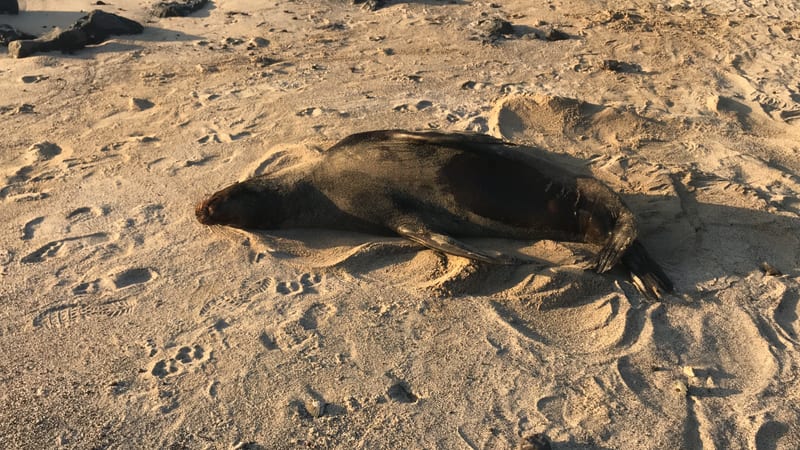
Asleep on the public beach in town, in among the footprints. Nobody moved it; you walk around it Puerto Baquerizo Moreno, San Cristóbal · January 2019 -
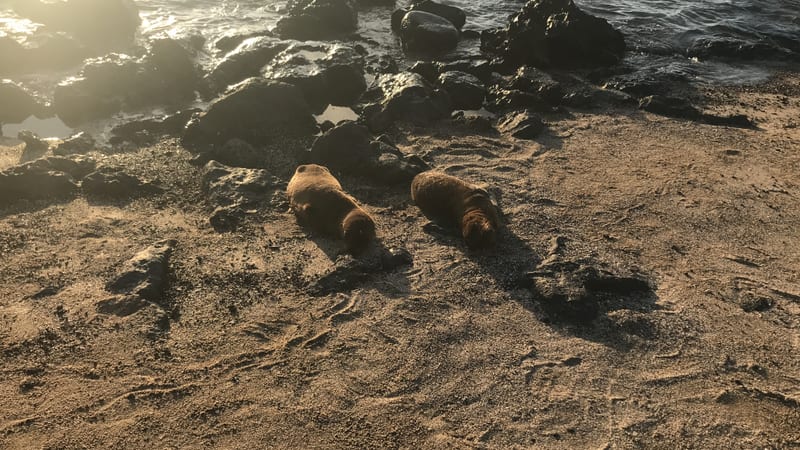
Two pups on the sand at the end of the day, where the lava meets the beach Puerto Baquerizo Moreno, San Cristóbal · January 2019


When to go for this one
Year-round. Pups are born roughly May to January, with a peak around August to November — the cool season is when the colonies are busiest.
The archipelago has two seasons and they are good at different things — we break both down here, month by month.
How to tell it apart
- Visible external ear flaps — that is what separates a sea lion from a seal.
- Males have a raised bump on the forehead and are two to three times the weight of females.
- They walk on all fours: the hind flippers rotate forward, which true seals cannot do.
What it does, and why
- Bulls hold a stretch of beach and bark continuously to defend it. That barking is the soundtrack of a Galápagos night.
- Juveniles are relentlessly curious underwater and will approach snorkellers directly.
- Mothers recognise their own pup by call among hundreds on a crowded beach.
Why people miss it, and who it is not for
This is the part we can write and an encyclopedia cannot: what actually goes wrong when someone comes looking for this animal. It is from running these islands, not from a field guide.
They are not tame, they are unafraid, and that is different
A bull defending a beach will charge, and he is faster than you on sand. The barking male patrolling the shoreline is not playing. Guides move groups away from them for a reason, and every season someone gets bitten because they wanted a photograph.
In the water, the rule works the other way round
Stay still and juveniles will come and play. Swim towards them and they leave. Every visitor learns this on their second snorkel and wishes they had known on the first.
Pups on a beach alone are not abandoned
The mother is at sea feeding and will come back. People try to help every year. Approaching a pup can cause the mother to reject it, which is the one way a well-meaning tourist actually kills a sea lion.
Conservation status
IUCN Red List: Endangered
Listed Endangered. The population has fallen by more than half since the 1970s, driven by El Niño events that collapse the fish they eat, and by disease and dog attacks on inhabited islands.
Questions people ask about the galápagos sea lion
Can you swim with Galápagos sea lions?
You do not swim with them; they decide to swim with you, which is better. Juveniles routinely approach snorkellers at Santa Fé, Kicker Rock and Concha de Perla. The rule is that you never approach, touch or chase them — let them come.
Are Galápagos sea lions dangerous?
Territorial bulls are, and guides will keep you well clear of one. A bull defending a stretch of beach can and will charge. Females and juveniles are not a threat.
What is the difference between a sea lion and a seal?
Sea lions have visible ear flaps and can rotate their hind flippers forward to walk. Seals have neither. Galápagos has both: the sea lion everywhere, and the much shyer Galápagos fur seal on rockier northern coasts.
Why are they endangered if there are so many?
Because the trend matters more than the count. Numbers have dropped by over half since the 1970s, and a single strong El Niño can kill a large share of one year’s pups by starving out the fish.
What else is on the same islands
These share at least one island with the galápagos sea lion. On a real day out you are likely to see several of them on the same walk.
- Galápagos giant tortoise — Isabela, San Cristóbal
- Marine iguana — Isabela, San Cristóbal
- Galápagos penguin — Isabela
- Green sea turtle — Isabela, San Cristóbal
- Galápagos shark — San Cristóbal
- Scalloped hammerhead — San Cristóbal
- Red-lipped batfish — Isabela
- Waved albatross — Española
- Magnificent frigatebird — San Cristóbal
- Flightless cormorant — Isabela
- Galápagos land iguana — Santa Fé, Isabela
- Galápagos fur seal — Isabela
- Sally Lightfoot crab — Isabela
- Blue-footed booby — Española, Isabela, San Cristóbal
- Galápagos hawk — Española, Santa Fé, Isabela
