

Española Island
Short answer
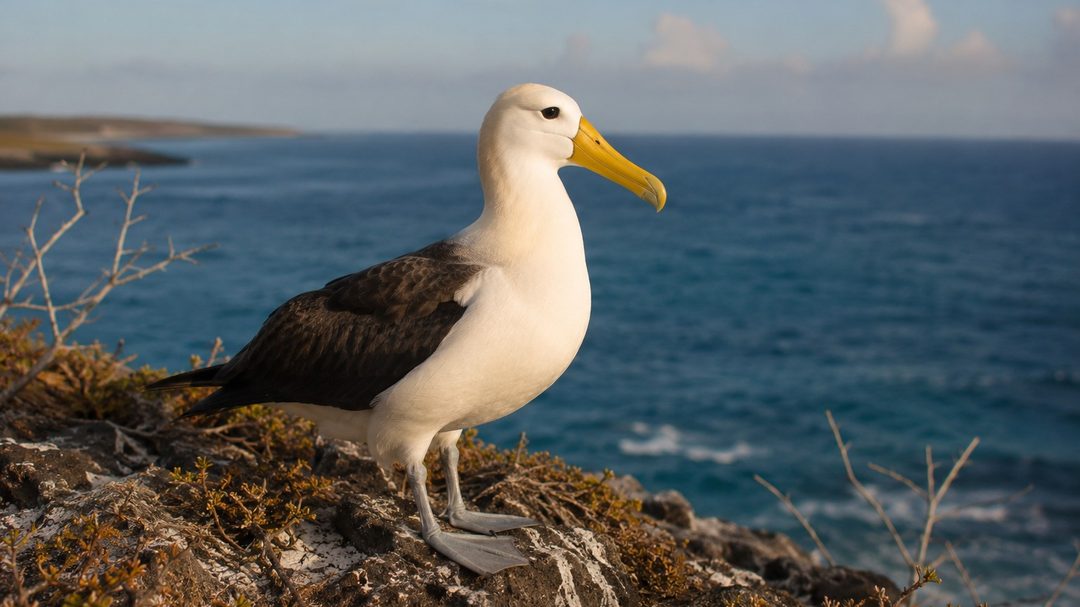
Española is the oldest island in the Galápagos — around four million years — and the flattest, because it has been eroding since long before the others rose. It is the only place on Earth where the waved albatross nests, which it does between roughly April and December. There is no settlement and no accommodation: you reach it on a cruise, and the two landing sites are Punta Suárez and Gardner Bay.
On this page — 8 sections
Española nearly lost its tortoises entirely — fourteen animals were left. All of them were taken into captive breeding, and their descendants, more than two thousand of them, have been returned. Almost every Española tortoise alive today descends from those fourteen, and a disproportionate number from one male called Diego.
Española at a glance
| Also called | Hood Island |
|---|---|
| Age | Around 4 million years — the oldest of the main islands |
| Population | None. No settlement, no hotels |
| Access | Cruise only |
| Landing sites | Punta Suárez and Gardner Bay |
| Famous for | The waved albatross — it nests nowhere else on Earth |
Getting there
This is the part that decides whether Española belongs in your trip, so it goes first rather than last. How you reach the archipelago at all →
- Cruise
- The only way. Southern and eastern itineraries include it, usually as a full day with a landing at Punta Suárez in the morning and Gardner Bay in the afternoon.
- Day tour
- Not possible. It is too far from the inhabited islands for a day return, and no operator runs one.
- Staying over
- There is nowhere to stay and no landing outside the two visitor sites. This is a genuinely uninhabited island.
What is on the island
- 1
A rocky headland with the densest concentration of wildlife in the archipelago on one walk: albatross colonies in season, red-and-green marine iguanas, blue-footed and Nazca boobies nesting beside the path, and a blowhole that throws water twenty metres up.
- 2
A long, white, almost blindingly bright beach with a resting sea lion colony and no path — you walk the sand. Snorkelling off the nearby islets is excellent.
- Punta Suárez
- A rocky headland with the densest concentration of wildlife in the archipelago on one walk: albatross colonies in season, red-and-green marine iguanas, blue-footed and Nazca boobies nesting beside the path, and a blowhole that throws water twenty metres up. What it is really like →
- Gardner Bay
- A long, white, almost blindingly bright beach with a resting sea lion colony and no path — you walk the sand. Snorkelling off the nearby islets is excellent. What it is really like →
Every visitor site we have written up →
The history, which is the point
Most Galápagos islands are wildlife and geology. Española is those, plus two hundred years of people behaving strangely on a small piece of rock.
- 4 million years agoEspañola forms over the hotspot. It has been drifting east and eroding ever since, which is why it is low and flat while Isabela is still building.
- 1960sA survey finds just fourteen surviving Española tortoises, too scattered to breed. All are taken to the Darwin Station on Santa Cruz.
- 1976A male named Diego is repatriated from San Diego Zoo and joins the programme. He turns out to be an extraordinarily prolific breeder.
- 2020The programme closes as a success. Diego and the others are returned to Española. More than two thousand tortoises now live on the island.
What you see
- Waved albatross — Roughly April to December. The entire world population — around 12,000 breeding pairs — nests here and nowhere else. Outside the season the island is empty of them.
- Marine iguana — The Española population turns red and green in the breeding season. They look like no other marine iguana in the archipelago.
- Blue-footed booby — Nesting on open ground beside the path, alongside Nazca boobies.
- Galápagos sea lion — A large resting colony along the whole length of Gardner Bay.
- Española mockingbird — Bold to the point of rudeness — it will land on your bag. Found only here.
Every species, with the exact sites →
Can you stay here?
No. Española is uninhabited — there is no settlement, no accommodation and no landing outside the marked visitor sites. You come for a few hours and you leave. The four islands you can actually sleep on →
What we would tell you first
The albatross season is the whole visit
They arrive around April and are gone by December or January. Outside that window Punta Suárez is still an excellent walk, but the animal people came for is at sea, thousands of kilometres away. If the albatross is your reason, check the month before you book the cruise.
There is no way to get here without a cruise
We have been asked many times and the answer does not change. No day tour reaches Española from Santa Cruz or San Cristóbal.
Punta Suárez is uneven ground
The trail is loose lava boulders for much of its length. It is not long, but it needs decent footing and a stick helps.
The other islands you visit but cannot stay on
- Bartolomé — The most photographed view in the Galápagos, a 114-metre boardwalk climb, and a landscape that looks like the moon. A day trip from Santa Cruz.
- Fernandina — Fernandina: under 1 million years old, still erupting, and the largest island on Earth with no introduced species established. One landing, cruise only.
- Genovesa — Genovesa, the drowned caldera in the far north: the largest seabird colonies in the islands, most of the red-footed boobies, and a 25 m cliff staircase.
- Santiago — Where Darwin spent nine days ashore, where the fur seals swim in eroded lava grottoes, and where a 130-year-old lava flow still looks a week old.
- Santa Fé — Santa Fé: around 4 million years old, and the easiest outer island to reach from Puerto Ayora. A turquoise bay of sea lions, and its own land iguana.
- North Seymour — North Seymour: a flat slab of uplifted seabed 20 minutes from the Baltra channel, with a 2 km loop past nesting blue-footed boobies and frigatebirds.
All eleven compared, side by side →
Trips that reach Española
None of them quite it? Tell us what you want and we build it →
Questions people also ask
What is Española Island famous for?
It is the only nesting site on Earth for the waved albatross, which returns between roughly April and December. It is also the oldest island in the archipelago, home to the red-and-green marine iguanas found nowhere else, and the site of the most celebrated tortoise recovery in conservation.
When can you see the albatross on Española?
Roughly April to December. They arrive to breed, raise a single chick, and leave. From January to March the island has none — they are out over the open Pacific.
How do you get to Española Island?
By cruise only. There is no settlement, no airport and no day-tour service from the inhabited islands. Southern and eastern cruise itineraries include it.
What is the story of Diego the tortoise?
Española’s tortoises fell to fourteen animals. A male called Diego was repatriated from San Diego Zoo in 1976 and proved extraordinarily prolific. When the breeding programme closed in 2020, more than two thousand tortoises had been returned to the island, a large share of them his descendants.
Sources
Every figure on this page comes from one of these. If one of them changes and we have not caught up, tell us and we will fix it the same day.
- Galápagos National Park Directorate — Visitor sites, landing rules and which islets are closed to landings.
- Galápagos Conservation Trust — Independent conservation reporting, including the Floreana restoration programme.
- Ecuador Ministry of Tourism — service portal — Ecuador’s register of licensed operators — where our own licence is listed.
Planning this trip yourself?
Send us the dates and what you actually want to see. A planner in Cuenca reads it and replies within one business day — not a template, and not a bot.
Plan your trip