

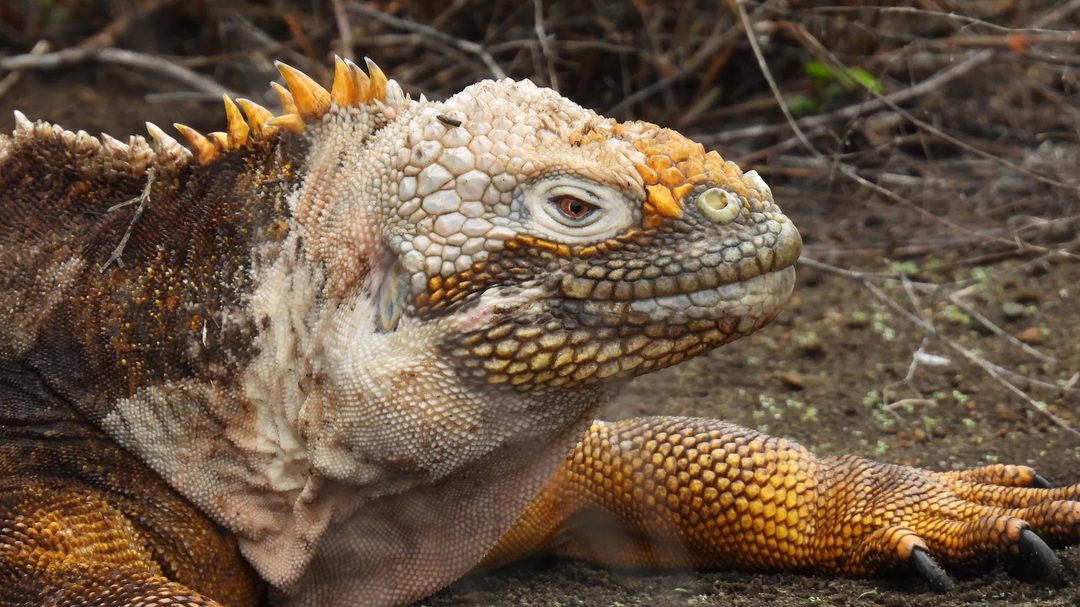
Galápagos wildlife · Reptile · Endemic
The Galápagos land iguana
Conolophus subcristatus · Iguanidae
Photo: TheMongrelKoi · iNaturalist · CC0 1.0 · Galápagos National Park
Short answer
The land iguana is the yellow one — and it is a different animal from the black marine iguana people usually picture. It lives in the dry lowlands, eats prickly pear cactus, spines and all, and lives for half a century. There are three species in the archipelago: the widespread one, a paler species found only on Santa Fé, and the pink iguana of Wolf Volcano, which was not recognised as distinct until 2009.
Actual size
nose to tail tip.
- Length
- 1.1 m
- Weight
- to 13 kg
- Lifespan
- 50–60 years
There is a pink one. On the rim of Wolf Volcano on Isabela lives a species of land iguana that is genuinely pink, was not recognised as distinct until 2009, and split from the others several million years ago — before most of the islands it could have lived on even existed.
Where you actually see one
This is the part a general encyclopedia cannot tell you: not where the species occurs, but which sites you can stand on, and what each one is like.
- 1
North Seymour — The nesting colony trail
Under the bushes along the flat loop. The population here is the source that repopulated Baltra.
- 2
The Santa Fé species — paler and larger, found on this island only. Sheltering under the tree cactus.
- 3
Santa Cruz — Charles Darwin Station
In the breeding enclosures, alongside the tortoises.
- 4
Isabela — Urbina Bay
Large yellow individuals on a western cruise landing.
When to go for this one
Year-round. They are more visible in the morning, when they bask, and shelter through the heat of the day — plenty of visitors walk a trail at noon and see none. Courtship and nesting run roughly January to March, when males turn a deeper orange and become territorial.
The archipelago has two seasons and they are good at different things — we break both down here, month by month.
How to tell it apart
- Yellow to orange-brown, sometimes almost gold. Nothing else in the islands is that colour.
- Bulkier and shorter-tailed than a marine iguana, with a lower crest.
- A heavy jowl and a blunt head, built for biting through cactus pads.
- On land only — it does not swim, and it is never found on the tidal rock where marine iguanas pile up.
What it does, and why
- It eats prickly pear cactus, spines included. It will roll a fallen pad on the ground to knock the worst off, then eat the rest without apparent difficulty.
- It gets most of its water from that cactus, and can go long periods without drinking at all.
- It has a working arrangement with finches: the iguana raises itself high on its legs and holds still, and the birds pick ticks off its skin.
- Females may walk several kilometres to reach traditional nesting ground, including up onto volcano rims.
Why people miss it, and who it is not for
This is the part we can write and an encyclopedia cannot: what actually goes wrong when someone comes looking for this animal. It is from running these islands, not from a field guide.
Walk the trail at noon and you will see none
They bask early and shelter under the cactus through the heat. Groups that land at eleven and walk in full sun regularly see nothing and assume the island is empty. Ask for the morning slot.
People confuse it with the marine iguana and think they have seen both
One is yellow, inland, and eats cactus. The other is black, on tidal rock, and grazes algae underwater. Seeing a pile of black iguanas at Tortuga Bay is not seeing a land iguana.
The pink one is not on any itinerary
It lives on the rim of Wolf Volcano, an active volcano on northern Isabela, in an area closed to visitors. No tour reaches it, and anyone offering one is not telling you the truth.
Conservation status
IUCN Red List: Vulnerable
Vulnerable. The Baltra population was wiped out entirely during the wartime occupation of the island, and was later restored using animals that had been moved to North Seymour in the 1930s — an accidental insurance policy. In 2019 land iguanas were returned to Santiago after an absence of nearly two centuries. The pink iguana of Wolf Volcano is Critically Endangered, with a few hundred animals on a single active volcano.
Questions people ask about the galápagos land iguana
What is the difference between a land iguana and a marine iguana?
They are separate species with a common ancestor. The land iguana is yellow, lives inland, eats cactus and does not swim. The marine iguana is black, lives on tidal rock and grazes algae underwater. You will not find them in the same place.
Where can you see land iguanas in the Galápagos?
North Seymour is the easiest — a twenty-minute boat ride from Santa Cruz, with iguanas under the bushes beside the trail. Santa Fé has its own paler species found nowhere else, and there are breeding enclosures at the Darwin Station on Santa Cruz.
Do land iguanas really eat cactus spines?
Yes. Prickly pear is the bulk of the diet and they eat the pads whole, spines included. Some individuals roll a fallen pad on the ground first to break the worst of them off, but plenty do not bother.
What is the pink iguana of Galápagos?
Conolophus marthae, a genuinely pink land iguana that lives only on the rim of Wolf Volcano on northern Isabela. It was first noticed by park rangers in 1986 and only described as a separate species in 2009. It is Critically Endangered — a few hundred animals on one active volcano.
What else is on the same islands
These share at least one island with the galápagos land iguana. On a real day out you are likely to see several of them on the same walk.
- Galápagos giant tortoise — Santa Cruz, Isabela
- Marine iguana — Santa Cruz, Isabela
- Galápagos sea lion — Santa Fé, Isabela
- Galápagos penguin — Isabela
- Green sea turtle — Santa Cruz, Isabela
- Galápagos shark — Santa Cruz
- Scalloped hammerhead — Santa Cruz
- Red-lipped batfish — Santa Cruz, Isabela
- Magnificent frigatebird — North Seymour
- Flightless cormorant — Isabela
- Galápagos fur seal — Isabela
- Sally Lightfoot crab — Santa Cruz, Isabela
- Blue-footed booby — North Seymour, Isabela
- Galápagos hawk — Santa Fé, Isabela
