

Isabela Island
Short answer
Isabela is the largest island in the Galápagos — bigger than all the others put together — and the most volcanically alive: five volcanoes, several of them still active. It is also the quietest of the three islands you can stay on. Its village, Puerto Villamil, has sand for streets. You reach it by a two-hour boat from Santa Cruz, and almost everything worth seeing is walkable, cyclable or a short panga ride away — including the most reliable penguins in the archipelago.
On this page — 8 sections
Isabela is shaped like a seahorse because it is not one island. It is six volcanoes that grew until their lava flows met and fused. Some of the tortoise populations on either side of those saddles evolved separately, and still differ.
Isabela at a glance
| Also called | Albemarle Island |
|---|---|
| Size | The largest island — more land than all the others combined |
| Volcanoes | Five, several still active. Wolf Volcano is the highest point in the archipelago |
| Population | Around 2,000 — the quietest inhabited island |
| Settlement | Puerto Villamil |
| From Santa Cruz | About 2 hours by speedboat |
Getting there
This is the part that decides whether Isabela belongs in your trip, so it goes first rather than last. How you reach the archipelago at all →
- Speedboat from Santa Cruz
- The standard route. Roughly two hours from Puerto Ayora, usually two departures a day. It is open ocean in a small fast boat and it is genuinely rough from June to November.
- Inter-island light aircraft
- A small airstrip takes light aircraft from Baltra and San Cristóbal. About thirty minutes instead of two hours, several times the price, and a strict luggage limit. Worth it if you get seasick.
- Cruise
- Western itineraries call at the Isabela coast and at Fernandina opposite, which is the only way to reach the far side of the island — Punta Espinosa, Urbina Bay, Tagus Cove. None of those are reachable from Puerto Villamil.
- From the mainland
- Not possible. There are no flights from Quito or Guayaquil to Isabela. You arrive at Baltra or San Cristóbal first — see how the whole chain works.
What is on the island
- 1
A cluster of lava islets a few minutes by panga from the pier, split by a narrow channel where whitetip reef sharks rest by day. Penguins, marine iguanas and sea lions on the rock around it. The single easiest wildlife hour in the islands.
- 2
A sheltered natural pool reached by a boardwalk through mangrove, a short walk from the pier. Free, no guide needed, and turtles and sea lions come to you. Go at high tide.
- 3
Collapsed lava tubes forming arches and channels in shallow clear water. Turtles under the arches, seahorses if you are lucky, and penguins fishing the shallows. A boat trip, and the crossing out is exposed.
- 4
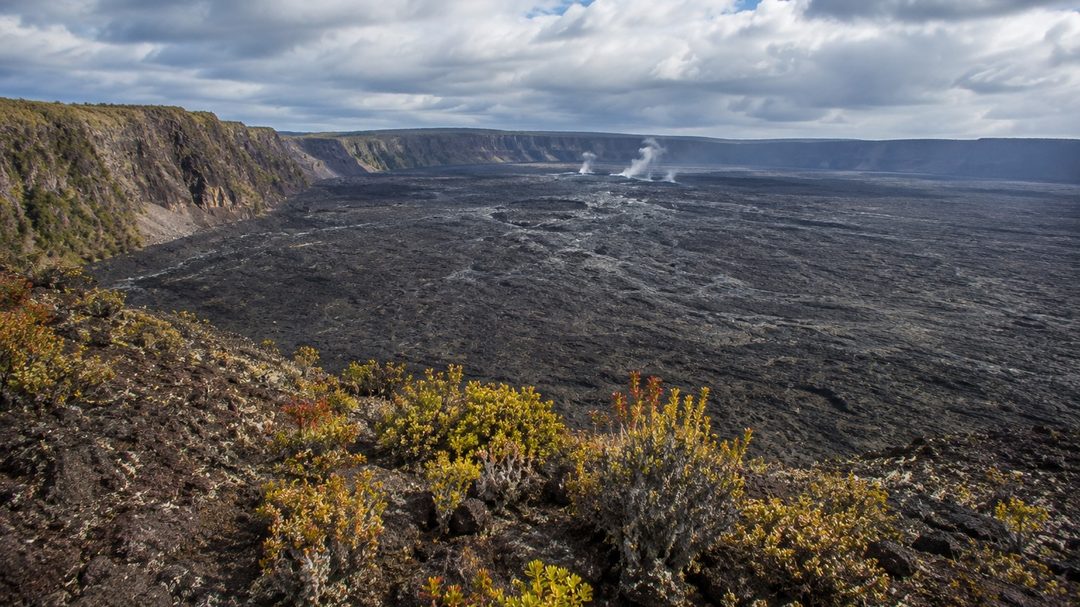
One of the largest volcanic calderas on Earth — around ten kilometres across. The walk to the rim is long and often muddy, and the reward is a black plain that goes to the horizon.
- 5
A wall of lava blocks built by prisoners of a penal colony that ran here until 1959, for no reason except to keep them working. Men died building it. It is a bike ride from town, through the wetlands.
- 6
The wetland boardwalks between town and the wall: lagoons, flamingos, and the Arnaldo Tupiza tortoise breeding centre.
- Las Tintoreras
- A cluster of lava islets a few minutes by panga from the pier, split by a narrow channel where whitetip reef sharks rest by day. Penguins, marine iguanas and sea lions on the rock around it. The single easiest wildlife hour in the islands. What it is really like →
- Concha de Perla
- A sheltered natural pool reached by a boardwalk through mangrove, a short walk from the pier. Free, no guide needed, and turtles and sea lions come to you. Go at high tide. What it is really like →
- Los Túneles
- Collapsed lava tubes forming arches and channels in shallow clear water. Turtles under the arches, seahorses if you are lucky, and penguins fishing the shallows. A boat trip, and the crossing out is exposed. What it is really like →
- Sierra Negra
- One of the largest volcanic calderas on Earth — around ten kilometres across. The walk to the rim is long and often muddy, and the reward is a black plain that goes to the horizon. What it is really like →
- The Wall of Tears
- A wall of lava blocks built by prisoners of a penal colony that ran here until 1959, for no reason except to keep them working. Men died building it. It is a bike ride from town, through the wetlands. What it is really like →
- The far side, and Fernandina
- Punta Vicente Roca, Urbina Bay and Tagus Cove are on the west coast, and Fernandina lies opposite. None are reachable from Puerto Villamil — they need a western cruise.
- Los Humedales
- The wetland boardwalks between town and the wall: lagoons, flamingos, and the Arnaldo Tupiza tortoise breeding centre. What it is really like →
Every visitor site we have written up →
The history, which is the point
Most Galápagos islands are wildlife and geology. Isabela is those, plus two hundred years of people behaving strangely on a small piece of rock.
- 1593Named Albemarle by an English buccaneer. For two centuries the island is a water stop and a larder — whalers take tortoises alive as fresh meat that keeps for months.
- 1946–1959Ecuador runs a penal colony at Puerto Villamil. The Wall of Tears is what is left of it.
- 1998Cerro Azul erupts; tortoises are airlifted out of the path of the lava. It happens again in 2005 and 2018. This is a working volcanic island, not a monument.
- 2015Wolf Volcano erupts for the first time in thirty-three years — the only home of the pink land iguana, a species found nowhere else and identified as distinct only in 2009.
What you see
- Galápagos penguin — The most reliable sighting in the archipelago that does not need a cruise. Tintoreras and Los Túneles.
- Marine iguana — Isabela holds the largest marine iguanas anywhere. Piled on the black rock at the water’s edge.
- Galápagos giant tortoise — Five volcanoes historically meant distinct populations on each. The breeding centre is a walk from town.
- Green sea turtle — Concha de Perla and the channels at Los Túneles — often within arm’s reach in still water.
- Greater flamingo — The lagoons on the walk to the Wall of Tears, most mornings.
Every species, with the exact sites →
Staying over
Puerto Villamil is small, sandy and low-key: family guesthouses, a handful of comfortable beachfront hotels, and no resort. The beach in front of town is long and usually empty. Power and water are more limited than on Santa Cruz. Most people who stay two nights wish they had booked three.
What we would tell you first
The crossing decides this island
Two hours each way in a small fast boat. From June to November that channel is rough, and Isabela is the crossing people remember badly. If you know you are susceptible, take the light aircraft one way — it costs more and it saves the trip.
Sierra Negra is a real walk
Long, exposed and frequently muddy, and the caldera is often in cloud. It is worth it on a clear morning and disappointing in the rain, and nobody can tell you in advance which you will get.
The far side is cruise-only
Punta Espinosa, Urbina Bay, Tagus Cove and Wolf Volcano are on the western side. There is no road and no boat service from Puerto Villamil. If those are what you came for, you need a cruise, and we will say so.
The islands you can stay on
- Floreana — Floreana: the post barrel that has worked since 1793, the 1930s disappearances nobody solved, Devil’s Crown, and the honest problem of getting there.
- Santa Cruz — Santa Cruz: around 15,000 people and the hub of the archipelago — the Darwin Station, wild highland tortoises, Tortuga Bay, and an airport 90 minutes away.
- San Cristóbal — San Cristóbal: the capital, around 7,000 people, the first island Darwin set foot on in 1835, and the only one where the airport is 10 minutes from town.
All eleven compared, side by side →
Trips that reach Isabela
- 5-Day Galápagos: Santa Cruz & Isabela 5 days · from US$1,337
- 8-Day Galápagos: San Cristóbal, Santa Cruz & Isabela 8 days
- 6-Day Galápagos Multisport 6 days
None of them quite it? Tell us what you want and we build it →
Questions people also ask
Is Isabela Island worth visiting?
If you have five days or more in the Galápagos, yes — it is the quietest of the three inhabited islands and it has the best land-based wildlife access in the archipelago. Tintoreras and Concha de Perla give you penguins, sharks, turtles and iguanas within an hour of town, without a cruise. The trade is the two-hour boat crossing each way.
How do you get to Isabela Island?
By boat or by light aircraft, from within the archipelago — there are no flights from mainland Ecuador. The usual route is a two-hour speedboat from Puerto Ayora on Santa Cruz, typically twice a day. A small inter-island plane does it in about thirty minutes for several times the price.
How many days do you need on Isabela?
Two nights is the working minimum and three is better. One night means you spend four hours of it on a boat. With three you get Tintoreras, Los Túneles, Sierra Negra and the wetlands without rushing any of them.
Can you see penguins on Isabela?
Yes — this is the most reliable place in the Galápagos to see Galápagos penguins without joining a cruise. They are regular at Las Tintoreras and fish the shallows at Los Túneles, where you may well meet one underwater while snorkelling.
Is the Sierra Negra hike hard?
It is long rather than steep — a sustained walk on an exposed, often muddy track. Reasonable fitness is enough. The bigger variable is cloud: the caldera is frequently in mist, and that is luck, not planning.
What is the Wall of Tears on Isabela?
A wall of lava blocks built by prisoners of the penal colony that operated at Puerto Villamil until 1959. It serves no purpose — it was built to keep men occupied, and men died doing it. It is reached by bike or on foot from town, through the wetlands.
Sources
Every figure on this page comes from one of these. If one of them changes and we have not caught up, tell us and we will fix it the same day.
- Galápagos National Park Directorate — Visitor sites, landing rules and which islets are closed to landings.
- Galápagos Conservation Trust — Independent conservation reporting, including the Floreana restoration programme.
- Ecuador Ministry of Tourism — service portal — Ecuador’s register of licensed operators — where our own licence is listed.
Planning this trip yourself?
Send us the dates and what you actually want to see. A planner in Cuenca reads it and replies within one business day — not a template, and not a bot.
Plan your trip