

Fernandina Island
Short answer
Fernandina is the youngest island in the Galápagos, the most volcanically active, and — this is the part that matters — the largest island on Earth with no introduced species established on it. No rats, no goats, no cats. There is one visitor site, Punta Espinosa, reachable only by cruise, and it holds the densest marine iguana colonies anywhere, the flightless cormorant, and lava flows that are younger than most of the people standing on them.
On this page — 8 sections
Fernandina has never been successfully invaded. Every other significant island in the archipelago has had rats, goats or cats introduced and then fought to remove them. Fernandina simply never let anything take hold, which makes it the closest thing left to what Darwin saw.
Fernandina at a glance
| Also called | Narborough Island |
|---|---|
| Age | Under 1 million years — the youngest of the main islands |
| Volcano | La Cumbre, one of the most active in the world |
| Population | None, and no introduced species established |
| Access | Cruise only. Western itineraries |
| Visitor site | Punta Espinosa — the only one |
Getting there
This is the part that decides whether Fernandina belongs in your trip, so it goes first rather than last. How you reach the archipelago at all →
- Cruise
- Western itineraries only, and not all of them. Fernandina sits on the far side of Isabela; there is no route to it from the inhabited islands.
- Day tour
- Does not exist. Puerto Villamil on Isabela is the nearest settlement and there is no service across.
- Staying over
- Nobody stays on Fernandina. There is one landing point and a single trail.
What is on the island
- 1
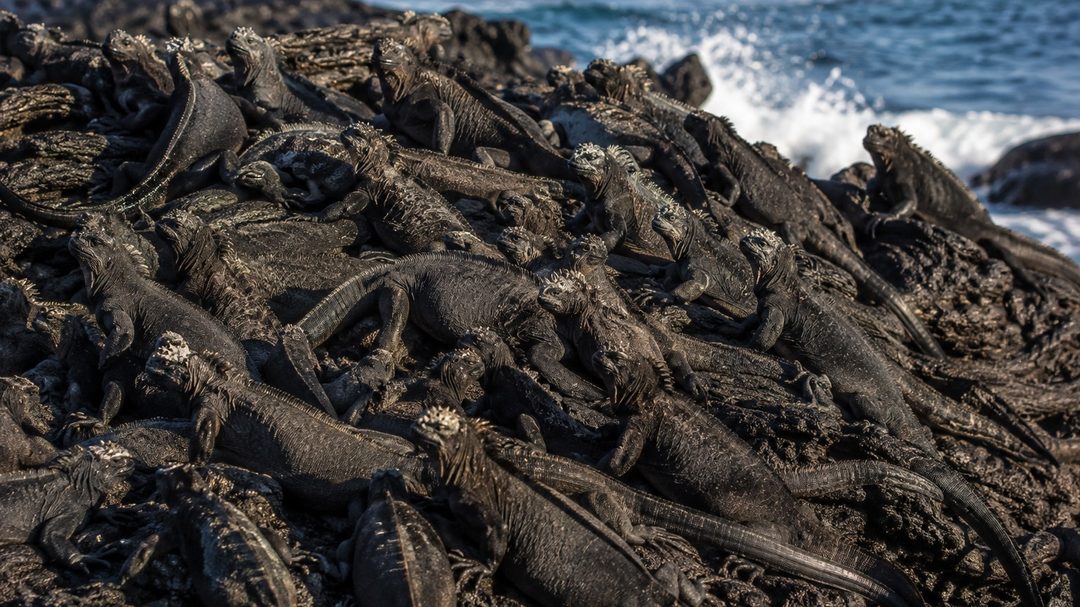
A spit of black lava on the north-east tip, and the only place visitors land. Hundreds of marine iguanas piled on the rock, flightless cormorants drying stunted wings, sea lions, and the sound of nothing else. The trail crosses fields of ropey pāhoehoe lava.
- 2
Across the channel on Isabela: a panga ride under collapsed tuff cliffs with mola mola, penguins and turtles in the cold upwelling. Usually paired with Fernandina on the same day.
- Punta Espinosa
- A spit of black lava on the north-east tip, and the only place visitors land. Hundreds of marine iguanas piled on the rock, flightless cormorants drying stunted wings, sea lions, and the sound of nothing else. The trail crosses fields of ropey pāhoehoe lava. What it is really like →
- Punta Vicente Roca
- Across the channel on Isabela: a panga ride under collapsed tuff cliffs with mola mola, penguins and turtles in the cold upwelling. Usually paired with Fernandina on the same day. What it is really like →
Every visitor site we have written up →
The history, which is the point
Most Galápagos islands are wildlife and geology. Fernandina is those, plus two hundred years of people behaving strangely on a small piece of rock.
- 1825A recorded eruption of La Cumbre. The volcano has erupted more than twenty-five times since records began.
- 1968The caldera floor collapses by around 300 metres in a matter of days — one of the largest recorded caldera collapses anywhere.
- 2019A Fernandina giant tortoise is found alive, a species not recorded since 1906 and widely assumed extinct. The find prompts renewed searches for others.
- 2020 and 2024Further eruptions of La Cumbre. This is not a historic volcano; it is a working one.
What you see
- Marine iguana — The densest colonies anywhere — hundreds on a single lava flow, piled on each other for warmth.
- Flightless cormorant — Found only on Fernandina and the west coast of Isabela. Around 2,000 individuals exist. Its wings are too small to fly and it dries them anyway.
- Galápagos penguin — The core of the world population lives on these two western coasts, where the cold upwelling is.
- Galápagos hawk — Often perched on the lava, unbothered by people.
- Green sea turtle — In the shallow bay, and nesting on the sand pockets.
Every species, with the exact sites →
Can you stay here?
No. Fernandina is uninhabited — there is no settlement, no accommodation and no landing outside the marked visitor sites. You come for a few hours and you leave. The four islands you can actually sleep on →
What we would tell you first
You cannot get here without a cruise, and not every cruise goes
Fernandina and the western Isabela coast are the least accessible part of the archipelago. If Punta Espinosa is on your list, check the specific itinerary — plenty of "western" cruises do not include it.
The biosecurity here is stricter, and it should be
This is the largest island on Earth with no established introduced species. Boots are inspected and bags are checked before landing. One pregnant rat would end four million years of isolation.
It is not comfortable walking
The trail is raw lava — sharp, uneven and hot. Closed shoes, not sandals.
The other islands you visit but cannot stay on
- Española — Española: around 4 million years old, the oldest main island, and the only nesting site on Earth for the waved albatross — some 12,000 pairs. Cruise only.
- Bartolomé — The most photographed view in the Galápagos, a 114-metre boardwalk climb, and a landscape that looks like the moon. A day trip from Santa Cruz.
- Genovesa — Genovesa, the drowned caldera in the far north: the largest seabird colonies in the islands, most of the red-footed boobies, and a 25 m cliff staircase.
- Santiago — Where Darwin spent nine days ashore, where the fur seals swim in eroded lava grottoes, and where a 130-year-old lava flow still looks a week old.
- Santa Fé — Santa Fé: around 4 million years old, and the easiest outer island to reach from Puerto Ayora. A turquoise bay of sea lions, and its own land iguana.
- North Seymour — North Seymour: a flat slab of uplifted seabed 20 minutes from the Baltra channel, with a 2 km loop past nesting blue-footed boobies and frigatebirds.
All eleven compared, side by side →
Trips that reach Fernandina
None of them quite it? Tell us what you want and we build it →
Questions people also ask
Why is Fernandina Island special?
It is the largest island on Earth with no introduced species established on it — no rats, goats or cats have ever taken hold. It is also the youngest and most volcanically active island in the Galápagos, and it holds the densest marine iguana colonies anywhere.
How do you get to Fernandina Island?
By cruise only, on western itineraries — and not all of them include it. There is no settlement, no airport, and no day-tour service. Puerto Villamil on Isabela is the nearest town and there is no route across.
Is Fernandina volcano still active?
Very. La Cumbre is among the most active volcanoes on Earth, with more than twenty-five recorded eruptions, most recently in 2020 and 2024. In 1968 its caldera floor collapsed by around 300 metres in days.
What can you see at Punta Espinosa?
Hundreds of marine iguanas on the lava, flightless cormorants — a species found only here and on western Isabela — sea lions, Galápagos hawks and penguins. It is the only visitor site on the island.
Sources
Every figure on this page comes from one of these. If one of them changes and we have not caught up, tell us and we will fix it the same day.
- Galápagos National Park Directorate — Visitor sites, landing rules and which islets are closed to landings.
- Galápagos Conservation Trust — Independent conservation reporting, including the Floreana restoration programme.
- Ecuador Ministry of Tourism — service portal — Ecuador’s register of licensed operators — where our own licence is listed.
Planning this trip yourself?
Send us the dates and what you actually want to see. A planner in Cuenca reads it and replies within one business day — not a template, and not a bot.
Plan your trip