

San Cristóbal Island
Short answer
San Cristóbal is the administrative capital of the Galápagos, the first island Darwin set foot on in 1835, and the only one where the airport is ten minutes from town rather than ninety. Its wildlife is at the door: sea lions occupy the municipal beach and the benches. Offshore, Kicker Rock is one of the best snorkelling and diving sites in the archipelago. It is the easiest island to arrive on and the one most itineraries skip.
On this page — 8 sections
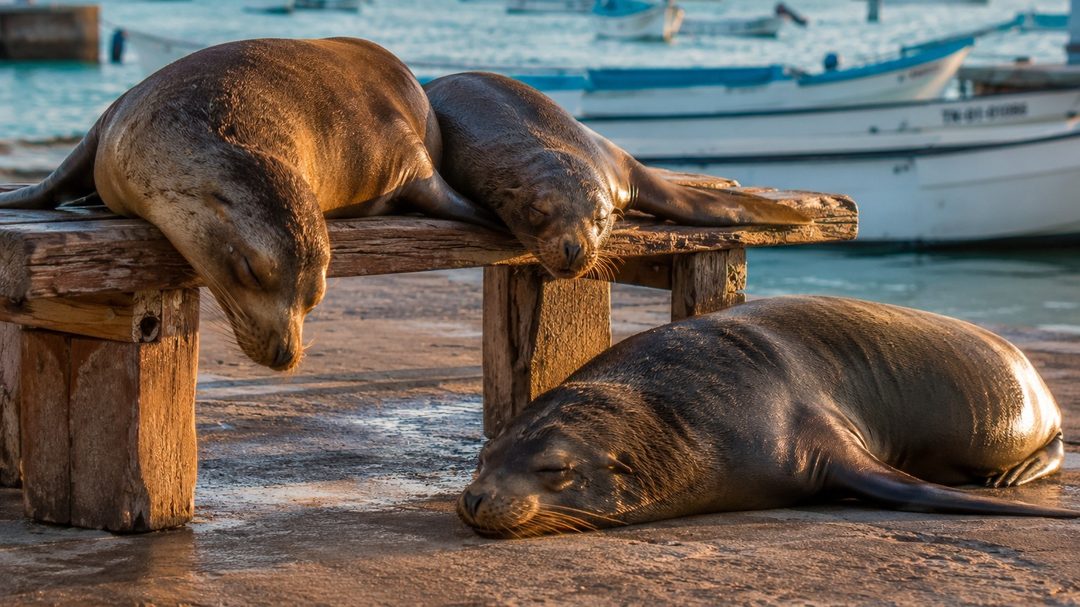
The sea lions of Puerto Baquerizo Moreno have taken the town. They sleep on the benches, the pier and the boats, and the boats have to be defended nightly. Nobody moves them, because moving them is illegal.
San Cristóbal at a glance
| Also called | Chatham Island |
|---|---|
| Status | Capital of the Galápagos province |
| Population | Around 7,000 |
| Settlement | Puerto Baquerizo Moreno |
| Airport | San Cristóbal (SCY) — about 10 minutes from town |
| Best known for | Kicker Rock, town sea lions and the Darwin landing |
Getting there
This is the part that decides whether San Cristóbal belongs in your trip, so it goes first rather than last. How you reach the archipelago at all →
- Fly to San Cristóbal (SCY)
- Direct from Quito or Guayaquil, and the airport is a short drive from town. If your trip starts here, this is by far the least tiring arrival in the archipelago.
- Speedboat from Santa Cruz
- About two hours, generally twice a day. There is no direct service to Isabela — everything routes through Santa Cruz.
- Cruise
- Many eastern and southern itineraries start or finish here, and most include Kicker Rock.
What is on the island
- 1
Two vertical walls of tuff rising over a hundred metres from open water, split by a narrow channel. You snorkel or dive the channel with hammerheads, Galápagos sharks, turtles and rays. It is the reason to come.
- 2
Town beaches with resident sea lion colonies, walkable from the centre. Punta Carola is the sunset one.
- 3
A headland above the bay with frigatebird colonies, a Darwin statue marking the landing, and a cove below it good for snorkelling straight off the rock.
- 4
A breeding centre with a natural-habitat enclosure on the far side of the island, a drive from town.
- 5
A crater lake in the highlands and one of very few permanent freshwater bodies in the archipelago. Frequently in cloud, which is part of it.
- 6
A white coral-sand beach on the north coast, reached by boat. Darwin came ashore near here.
- 7
The far north-east tip, and the only site in the archipelago where all three booby species nest together. A long boat trip and a steep climb.
- Kicker Rock (León Dormido)
- Two vertical walls of tuff rising over a hundred metres from open water, split by a narrow channel. You snorkel or dive the channel with hammerheads, Galápagos sharks, turtles and rays. It is the reason to come. What it is really like →
- Playa Mann and Punta Carola
- Town beaches with resident sea lion colonies, walkable from the centre. Punta Carola is the sunset one. What it is really like →
- Cerro Tijeretas
- A headland above the bay with frigatebird colonies, a Darwin statue marking the landing, and a cove below it good for snorkelling straight off the rock. What it is really like →
- La Galapaguera
- A breeding centre with a natural-habitat enclosure on the far side of the island, a drive from town. What it is really like →
- El Junco lagoon
- A crater lake in the highlands and one of very few permanent freshwater bodies in the archipelago. Frequently in cloud, which is part of it. What it is really like →
- Cerro Brujo
- A white coral-sand beach on the north coast, reached by boat. Darwin came ashore near here. What it is really like →
- Cruise connections
- Eastern and southern itineraries leave from here for Española and Floreana, the two southern islands with no day-trip access.
- Punta Pitt
- The far north-east tip, and the only site in the archipelago where all three booby species nest together. A long boat trip and a steep climb. What it is really like →
Every visitor site we have written up →
The history, which is the point
Most Galápagos islands are wildlife and geology. San Cristóbal is those, plus two hundred years of people behaving strangely on a small piece of rock.
- 1535The Bishop of Panama is blown off course and becomes the first recorded European to see the islands. He is unimpressed and notes there is no water.
- 1835On 16 September the Beagle anchors here. This is where Darwin first steps ashore in the Galápagos, and his first impression is of a place like hell — black lava, stunted scrub and heat.
- 1880sA sugar plantation and penal settlement operates in the highlands under Manuel J. Cobos, run with a brutality that ends with his murder by the workers.
- 1973Galápagos becomes a province of Ecuador and Puerto Baquerizo Moreno becomes its capital — which is why the island has government buildings and the archipelago’s only university campus.
What you see
- Galápagos sea lion — The largest and most habituated colonies in the islands, and they are in the town itself.
- Green sea turtle — Common in the Kicker Rock channel alongside the sharks and rays.
- Blue-footed booby — Nesting on the Kicker Rock ledges, and at Punta Pitt alongside red-footed and Nazca boobies.
- Marine iguana — On the rock along the whole town shoreline.
- Hammerhead shark — Schooling in the Kicker Rock channel, most reliably in the cool season from June to November.
Every species, with the exact sites →
Staying over
Puerto Baquerizo Moreno is smaller and calmer than Puerto Ayora, with a good spread of small hotels and a waterfront you can walk end to end in twenty minutes. Fewer boats leave from here, which is the trade: it is more pleasant to be in and less convenient to move from.
What we would tell you first
Kicker Rock is not a gentle snorkel
It is open water with current, deep on both sides, and the sharks are the point. Confident swimmers love it. It is not the place to try snorkelling for the first time, and guides will say so.
It is a dead end for onward travel
There is no direct boat to Isabela. Everything goes back through Santa Cruz, which costs a day. Build San Cristóbal at the start or the end of a trip, not the middle.
Most itineraries skip it, and that is a shame
Because the flights and the tour operators cluster on Baltra. If you are choosing where to fly into and your trip allows it, arriving here saves you the ninety-minute Baltra transfer entirely.
The islands you can stay on
- Floreana — Floreana: the post barrel that has worked since 1793, the 1930s disappearances nobody solved, Devil’s Crown, and the honest problem of getting there.
- Isabela — Isabela: bigger than all the other islands put together, 5 volcanoes, around 2,000 residents and sand for streets. Two hours by speedboat from Santa Cruz.
- Santa Cruz — Santa Cruz: around 15,000 people and the hub of the archipelago — the Darwin Station, wild highland tortoises, Tortuga Bay, and an airport 90 minutes away.
All eleven compared, side by side →
Trips that reach San Cristóbal
- 8-Day Galápagos: San Cristóbal, Santa Cruz & Isabela 8 days
- 6-Day Luxury Galápagos 6 days
- 6-Day Galápagos Multisport 6 days
None of them quite it? Tell us what you want and we build it →
Questions people also ask
What is San Cristóbal Island known for?
Kicker Rock — a pair of vertical rock walls in open ocean where you snorkel or dive with hammerheads and turtles — and for its town sea lions, which occupy the beaches, benches and boats of Puerto Baquerizo Moreno. It is also where Darwin first came ashore in the Galápagos, in September 1835.
Should I fly into San Cristóbal or Baltra?
It depends where your first night is, and the difference is bigger than it looks. San Cristóbal airport is ten minutes from town. Baltra is on a separate island and takes ninety minutes to two hours to Puerto Ayora. If your itinerary can start on San Cristóbal, you gain most of a day.
Can you swim with hammerhead sharks at Kicker Rock?
Yes, and it is one of the few places you can do it while snorkelling rather than diving. They school in the channel between the two walls, most reliably in the cool season, June to November. It is open water with current and it suits confident swimmers.
How many days do you need on San Cristóbal?
Two nights. One full day for Kicker Rock and one for the highlands, El Junco and La Galapaguera. Add a third if you want Punta Pitt, which is a long boat day on its own.
Is San Cristóbal better than Santa Cruz?
It is quieter, prettier to be in, and far easier to arrive at. Santa Cruz has more hotels, more restaurants and all the boat connections. If you are visiting one island, Santa Cruz is more practical; if you are visiting three, starting or ending on San Cristóbal is the better shape.
Sources
Every figure on this page comes from one of these. If one of them changes and we have not caught up, tell us and we will fix it the same day.
- Galápagos National Park Directorate — Visitor sites, landing rules and which islets are closed to landings.
- Galápagos Conservation Trust — Independent conservation reporting, including the Floreana restoration programme.
- Ecuador Ministry of Tourism — service portal — Ecuador’s register of licensed operators — where our own licence is listed.
Planning this trip yourself?
Send us the dates and what you actually want to see. A planner in Cuenca reads it and replies within one business day — not a template, and not a bot.
Plan your trip