

Bartolomé Island
Short answer
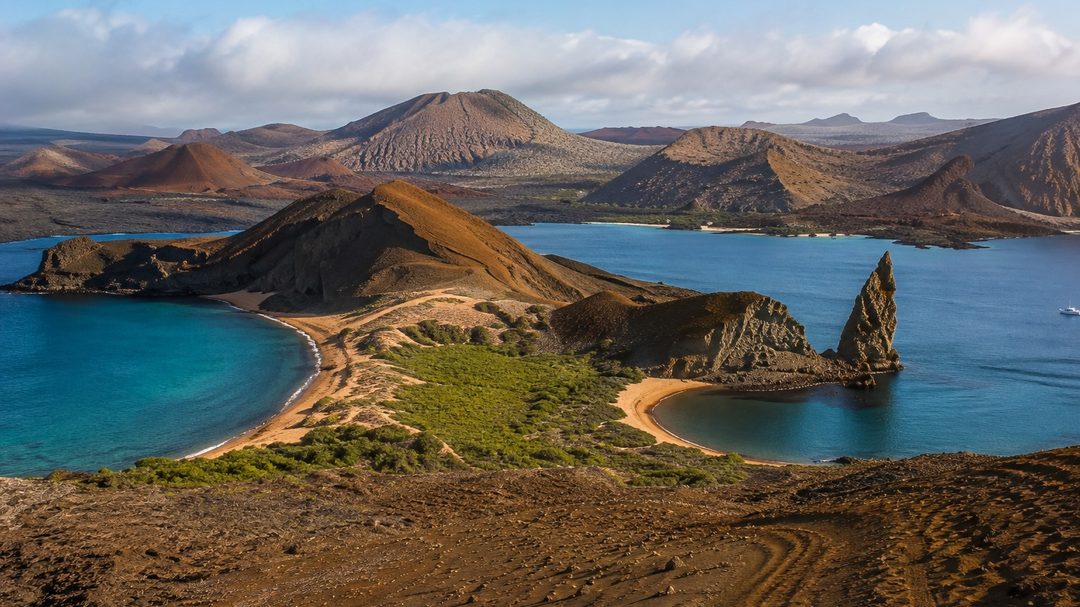
Bartolomé is the postcard: a spatter cone called Pinnacle Rock rising beside twin crescent bays, seen from a summit reached by a boardwalk of around 370 steps. The island itself is tiny, barren and almost lifeless — a young volcanic landscape of ash, cinder and lava that looks like the moon. It is reachable as a long day trip from Santa Cruz as well as on cruise itineraries, and the snorkel below Pinnacle Rock often has penguins.
On this page — 8 sections
Almost nothing grows on Bartolomé. The plants that do — a scattering of grey tiquilia — are among the first colonisers of new lava anywhere, and the island is used as a living study of how life gets started on bare rock.
Bartolomé at a glance
| Also called | Bartholomew Island |
|---|---|
| Size | Under 1.2 km² — one of the smallest visitor sites |
| Population | None |
| Access | Day trip from Santa Cruz, or cruise |
| The climb | A boardwalk of roughly 370 steps to the summit |
| Famous for | Pinnacle Rock and the view from the top |
Getting there
This is the part that decides whether Bartolomé belongs in your trip, so it goes first rather than last. How you reach the archipelago at all →
- Day trip from Santa Cruz
- A long day — roughly two hours each way by boat from Puerto Ayora, leaving early. One of the few outer islands you can do without a cruise.
- Cruise
- On most central and northern itineraries, usually as a morning landing followed by the snorkel.
- Staying over
- Not possible. There is nothing here.
What is on the island
- 1
A wooden staircase of around 370 steps climbing through cinder and spatter cones to a viewpoint. The boardwalk exists because the ground is too fragile to walk on. It is a steady climb, not a scramble, and there is no shade.
- 2
Pinnacle Rock and the beach below
A golden crescent beach at the foot of the spire. The snorkel here is shallow and sheltered, with reef fish, turtles and — often — Galápagos penguins around the base of the rock.
- 3
Across the channel on Santiago: a vast field of pāhoehoe lava from an 1897 flow, ropey and cracked and almost untouched. Often combined with Bartolomé on the same day.
- The summit boardwalk
- A wooden staircase of around 370 steps climbing through cinder and spatter cones to a viewpoint. The boardwalk exists because the ground is too fragile to walk on. It is a steady climb, not a scramble, and there is no shade. What it is really like →
- Pinnacle Rock and the beach below
- A golden crescent beach at the foot of the spire. The snorkel here is shallow and sheltered, with reef fish, turtles and — often — Galápagos penguins around the base of the rock. What it is really like →
- Sullivan Bay
- Across the channel on Santiago: a vast field of pāhoehoe lava from an 1897 flow, ropey and cracked and almost untouched. Often combined with Bartolomé on the same day. What it is really like →
Every visitor site we have written up →
The history, which is the point
Most Galápagos islands are wildlife and geology. Bartolomé is those, plus two hundred years of people behaving strangely on a small piece of rock.
- Geologically recentBartolomé is young — its cones and lava flows are barely weathered, which is exactly why it looks so lunar. The archipelago builds from west to east, and this is a late arrival.
- 1897The lava flow at Sullivan Bay opposite is dated to around this year, making it one of the youngest visible landscapes in the islands.
- 2003The summit boardwalk is built. Before it, visitors walked the cinder directly and the erosion was visible within a few seasons.
What you see
- Galápagos penguin — Often at the base of Pinnacle Rock — one of the more reliable sightings on a day trip from Santa Cruz.
- Green sea turtle — In the sheltered water off the beach; nesting on the north side.
- White-tipped reef shark — In the shallows around the rock, usually resting.
- Galápagos hawk — Occasionally over the summit. It is the archipelago’s only resident diurnal raptor.
Every species, with the exact sites →
Can you stay here?
No. Bartolomé is uninhabited — there is no settlement, no accommodation and no landing outside the marked visitor sites. You come for a few hours and you leave. The four islands you can actually sleep on →
What we would tell you first
The island is the view, not the wildlife
People arrive expecting a wildlife site and find a nearly sterile volcanic cone. The landscape is extraordinary and the snorkel is good, but if you want animals, Española or North Seymour give you far more in the same day.
370 steps with no shade
It is a steady boardwalk rather than a scramble, but it is exposed the whole way and most tours climb in the middle of the morning. Take water and a hat.
It is a long day from Santa Cruz
Two hours out, two hours back, in a small fast boat. Worth it for most people, and a bad idea if you are prone to seasickness.
The other islands you visit but cannot stay on
- Española — Española: around 4 million years old, the oldest main island, and the only nesting site on Earth for the waved albatross — some 12,000 pairs. Cruise only.
- Fernandina — Fernandina: under 1 million years old, still erupting, and the largest island on Earth with no introduced species established. One landing, cruise only.
- Genovesa — Genovesa, the drowned caldera in the far north: the largest seabird colonies in the islands, most of the red-footed boobies, and a 25 m cliff staircase.
- Santiago — Where Darwin spent nine days ashore, where the fur seals swim in eroded lava grottoes, and where a 130-year-old lava flow still looks a week old.
- Santa Fé — Santa Fé: around 4 million years old, and the easiest outer island to reach from Puerto Ayora. A turquoise bay of sea lions, and its own land iguana.
- North Seymour — North Seymour: a flat slab of uplifted seabed 20 minutes from the Baltra channel, with a 2 km loop past nesting blue-footed boobies and frigatebirds.
All eleven compared, side by side →
Trips that reach Bartolomé
- 8-Day Galápagos: San Cristóbal, Santa Cruz & Isabela 8 days
- 6-Day Luxury Galápagos 6 days
- 6-Day Galápagos Multisport 6 days
None of them quite it? Tell us what you want and we build it →
Questions people also ask
What is Bartolomé Island known for?
Pinnacle Rock and the view from the summit — the most photographed landscape in the Galápagos. A boardwalk of roughly 370 steps climbs through a lunar field of cinder cones to a viewpoint over twin crescent bays.
Can you visit Bartolomé on a day trip?
Yes. It is one of the few outer islands reachable from Puerto Ayora on Santa Cruz as a day trip — roughly two hours each way by boat. It is a long day and the crossing is exposed.
How many steps are there on Bartolomé?
Around 370, on a wooden boardwalk. It exists because the cinder slope is too fragile to walk on directly. It is a steady climb rather than a hard one, but there is no shade.
Can you see penguins on Bartolomé?
Often, yes — around the base of Pinnacle Rock during the snorkel. It is one of the more reliable penguin sightings available without going to Isabela.
Sources
Every figure on this page comes from one of these. If one of them changes and we have not caught up, tell us and we will fix it the same day.
- Galápagos National Park Directorate — Visitor sites, landing rules and which islets are closed to landings.
- Galápagos Conservation Trust — Independent conservation reporting, including the Floreana restoration programme.
- Ecuador Ministry of Tourism — service portal — Ecuador’s register of licensed operators — where our own licence is listed.
Planning this trip yourself?
Send us the dates and what you actually want to see. A planner in Cuenca reads it and replies within one business day — not a template, and not a bot.
Plan your trip