

Santa Fé Island
Short answer
Santa Fé is the easiest outer island to reach — a short boat ride from Puerto Ayora — and it delivers more than the effort suggests: a sheltered turquoise bay with a large and very playful sea lion colony, a forest of prickly pear cactus the size of trees, and its own species of land iguana, paler and found nowhere else. It is one of the oldest islands in the archipelago and it has no settlement.
On this page — 8 sections
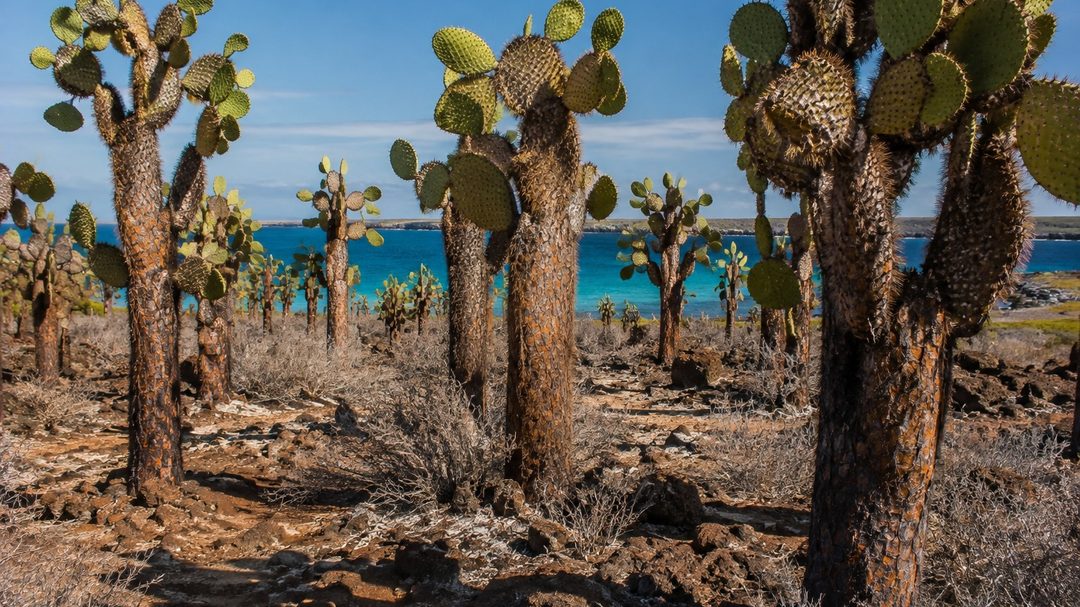
The prickly pear on Santa Fé grew into trees. On islands with tortoises and land iguanas eating them at ground level, the cactus that survived were the ones that grew a trunk — and here the trunks reach ten metres. It is evolution you can walk under.
Santa Fé at a glance
| Also called | Barrington Island |
|---|---|
| Age | Around 4 million years — among the oldest |
| Population | None |
| Access | Day trip from Santa Cruz, or cruise |
| Crossing | Under two hours from Puerto Ayora |
| Famous for | Sea lions, tree cactus and its own land iguana |
Getting there
This is the part that decides whether Santa Fé belongs in your trip, so it goes first rather than last. How you reach the archipelago at all →
- Day trip from Santa Cruz
- The standard way, and the shortest crossing to any outer island from Puerto Ayora. Usually a snorkel in the bay and a walk on the trail, back by mid-afternoon.
- Cruise
- On many central and eastern itineraries.
- Staying over
- Not possible.
What is on the island
- 1
A sheltered, shallow, extraordinarily clear bay on the north-east coast. The sea lion colony here includes a lot of juveniles, and juveniles are the ones that come and play. Turtles and rays in the same water.
- 2
A short loop from the landing through a forest of Opuntia echios — prickly pear grown into trees with thick woody trunks, some approaching ten metres. The Santa Fé land iguana lives underneath them.
- Santa Fé Bay
- A sheltered, shallow, extraordinarily clear bay on the north-east coast. The sea lion colony here includes a lot of juveniles, and juveniles are the ones that come and play. Turtles and rays in the same water. What it is really like →
- The cactus trail
- A short loop from the landing through a forest of Opuntia echios — prickly pear grown into trees with thick woody trunks, some approaching ten metres. The Santa Fé land iguana lives underneath them. What it is really like →
Every visitor site we have written up →
The history, which is the point
Most Galápagos islands are wildlife and geology. Santa Fé is those, plus two hundred years of people behaving strangely on a small piece of rock.
- 4 million years agoSanta Fé forms. It is one of the oldest surfaces in the archipelago, which is why it is low, weathered and covered in mature vegetation rather than raw lava.
- 1900sGoats introduced by fishermen strip the island. The endemic Santa Fé tortoise is already gone by then — the last records are from the nineteenth century.
- 1971The goats are eradicated. The cactus forest begins to regenerate.
- 2015Tortoises from Española are introduced as an ecological replacement for the extinct Santa Fé species, to restore the grazing role the island lost.
What you see
- Galápagos sea lion — A large colony with many juveniles. This is one of the best places in the archipelago to be played with in the water.
- Santa Fé land iguana — Paler and larger than the land iguanas elsewhere, and found on this island only. It shelters under the cactus and eats the fallen pads.
- Green sea turtle — Common in the shallow bay.
- Galápagos hawk — Over the trail, often perched on the cactus.
Every species, with the exact sites →
Can you stay here?
No. Santa Fé is uninhabited — there is no settlement, no accommodation and no landing outside the marked visitor sites. You come for a few hours and you leave. The four islands you can actually sleep on →
What we would tell you first
It is a half-day, and that is fine
Santa Fé is not a full-day island. Most trips are a snorkel and a short walk. If you want a big day out, Bartolomé or Floreana give you more — but they cost four hours of boat instead of two.
The land iguana is not guaranteed
They are there, but they shelter under the cactus in the heat and plenty of visitors walk the trail without seeing one. Morning is better.
The landing is wet
You step off the panga into shallow water. Fine for most people; worth knowing if you have mobility concerns.
The other islands you visit but cannot stay on
- Española — Española: around 4 million years old, the oldest main island, and the only nesting site on Earth for the waved albatross — some 12,000 pairs. Cruise only.
- Bartolomé — The most photographed view in the Galápagos, a 114-metre boardwalk climb, and a landscape that looks like the moon. A day trip from Santa Cruz.
- Fernandina — Fernandina: under 1 million years old, still erupting, and the largest island on Earth with no introduced species established. One landing, cruise only.
- Genovesa — Genovesa, the drowned caldera in the far north: the largest seabird colonies in the islands, most of the red-footed boobies, and a 25 m cliff staircase.
- Santiago — Where Darwin spent nine days ashore, where the fur seals swim in eroded lava grottoes, and where a 130-year-old lava flow still looks a week old.
- North Seymour — North Seymour: a flat slab of uplifted seabed 20 minutes from the Baltra channel, with a 2 km loop past nesting blue-footed boobies and frigatebirds.
All eleven compared, side by side →
Trips that reach Santa Fé
- 8-Day Galápagos: San Cristóbal, Santa Cruz & Isabela 8 days
- 6-Day Galápagos Multisport 6 days
- 5-Day Galápagos: Santa Cruz & Isabela 5 days · from US$1,337
None of them quite it? Tell us what you want and we build it →
Questions people also ask
What is Santa Fé Island known for?
A sheltered turquoise bay with a large and very playful sea lion colony, a forest of prickly pear cactus grown into trees up to ten metres tall, and its own species of land iguana — paler than the others and found nowhere else.
How do you get to Santa Fé Island?
It is the shortest crossing to any outer island from Puerto Ayora on Santa Cruz — under two hours — and a standard day trip. It is also on many cruise itineraries.
Can you snorkel with sea lions on Santa Fé?
Yes, and it is one of the best places for it. The colony has a lot of juveniles, and juveniles are the ones that approach, circle and try to get a reaction. You must not touch or chase them.
Why are the cactus so big on Santa Fé?
Because things ate them. On islands with tortoises and land iguanas grazing at ground level, the prickly pear that survived were those that grew tall woody trunks. On Santa Fé that pressure produced cactus the size of trees.
Sources
Every figure on this page comes from one of these. If one of them changes and we have not caught up, tell us and we will fix it the same day.
- Galápagos National Park Directorate — Visitor sites, landing rules and which islets are closed to landings.
- Galápagos Conservation Trust — Independent conservation reporting, including the Floreana restoration programme.
- Ecuador Ministry of Tourism — service portal — Ecuador’s register of licensed operators — where our own licence is listed.
Planning this trip yourself?
Send us the dates and what you actually want to see. A planner in Cuenca reads it and replies within one business day — not a template, and not a bot.
Plan your trip