

North Seymour Island
Short answer
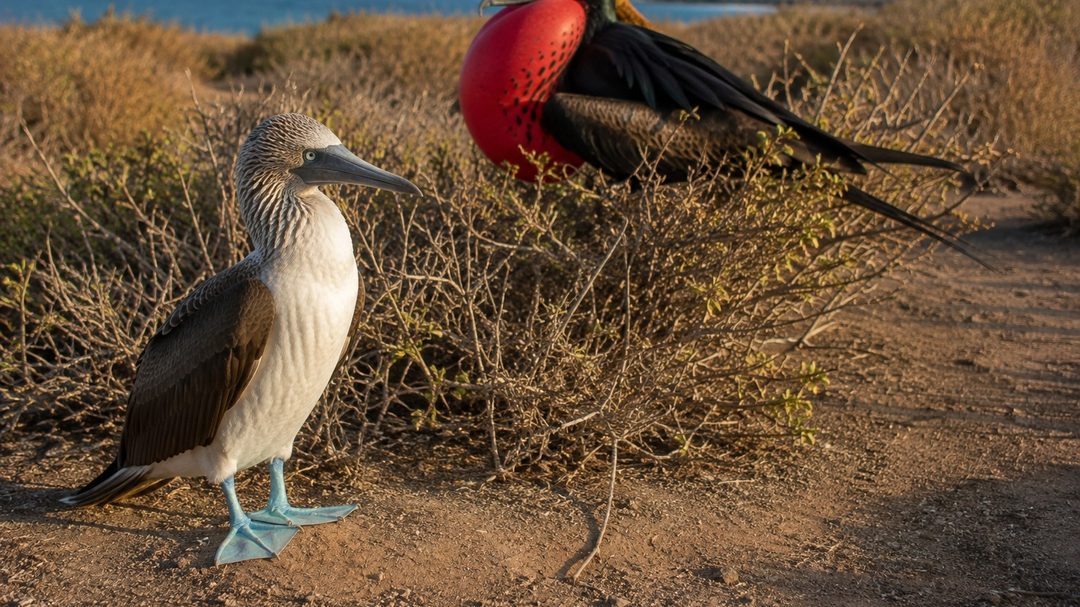
North Seymour is the most accessible seabird colony in the Galápagos: a flat, low island twenty minutes by boat from the Baltra airport channel, with blue-footed boobies nesting on open ground beside the path and frigatebird males inflating red throat pouches in the bushes above. It is a short day trip from Santa Cruz and the single best value half-day in the archipelago. Nobody lives there and there is nothing to stay in.
On this page — 8 sections
North Seymour is not a volcano. It is a slab of sea floor that was pushed up out of the water by tectonic uplift — which is why it is flat as a table when everything around it is a cone. You are walking on what used to be the bottom.
North Seymour at a glance
| Also called | Isla Seymour Norte |
|---|---|
| Origin | Uplifted seabed, not a volcano — which is why it is flat |
| Population | None |
| Access | Day trip from Santa Cruz — the shortest of any |
| The trail | A flat loop of about 2 km |
| Famous for | Blue-footed boobies and frigatebirds nesting beside the path |
Getting there
This is the part that decides whether North Seymour belongs in your trip, so it goes first rather than last. How you reach the archipelago at all →
- Day trip from Santa Cruz
- The shortest outer-island crossing there is — the boats leave from the Itabaca Channel by the airport, and it is around twenty minutes. Often combined with a snorkel at Las Bachas or Mosquera.
- Cruise
- On almost every central itinerary, usually as a first or last landing because of its proximity to Baltra.
- Staying over
- Not possible.
What is on the island
- 1
The nesting colony
A flat loop trail through low bushes and open ground. Blue-footed boobies nest directly on the path margins, courting and dancing at a metre or two. Frigatebird males sit in the bushes at eye level with their throat pouches inflated. Land iguanas underneath. It is the least effortful great wildlife walk in the islands.
- 2
Across the channel on Santa Cruz: a white beach with a flamingo lagoon behind it and turtle nesting tracks from December. Frequently paired with North Seymour.
- The nesting colony
- A flat loop trail through low bushes and open ground. Blue-footed boobies nest directly on the path margins, courting and dancing at a metre or two. Frigatebird males sit in the bushes at eye level with their throat pouches inflated. Land iguanas underneath. It is the least effortful great wildlife walk in the islands.
- Las Bachas
- Across the channel on Santa Cruz: a white beach with a flamingo lagoon behind it and turtle nesting tracks from December. Frequently paired with North Seymour. What it is really like →
Every visitor site we have written up →
The history, which is the point
Most Galápagos islands are wildlife and geology. North Seymour is those, plus two hundred years of people behaving strangely on a small piece of rock.
- GeologicallyThe island is a block of submarine lava lifted above sea level by tectonic movement, not built by an eruption. That is why it is flat and why its surface is old seabed.
- 1930sLand iguanas from Baltra are moved here in an early translocation experiment. When Baltra’s own population was later wiped out during the wartime occupation, the North Seymour animals became the source for reintroducing them.
- 1940sThe United States builds an airbase on neighbouring Baltra. The channel between the islands has been the main way into the archipelago ever since.
What you see
- Blue-footed booby — The classic site. Nests on open ground beside the path, courtship dances at very close range, and chicks in season.
- Magnificent frigatebird — Males inflate a scarlet throat pouch to the size of a football and sit in the bushes waiting. At eye level, a metre away.
- Galápagos land iguana — Under the bushes along the trail. The population here is the source that repopulated Baltra.
- Galápagos sea lion — On the rocks at the landing.
- Swallow-tailed gull — On the cliffs — the only fully nocturnal gull in the world.
Every species, with the exact sites →
Can you stay here?
No. North Seymour is uninhabited — there is no settlement, no accommodation and no landing outside the marked visitor sites. You come for a few hours and you leave. The four islands you can actually sleep on →
What we would tell you first
It is a half-day, and it is the best half-day here
Two kilometres of flat trail and a snorkel. If you have one spare morning on Santa Cruz and you want wildlife rather than landscape, this is the answer.
The frigatebird display is seasonal
Males inflate the pouch to attract a mate, mostly between roughly March and June, though some display year-round. Outside that window you will see frigatebirds, just not the red balloon.
There is no shade on the trail
Flat, exposed, and usually walked in the morning heat. Hat and water.
The other islands you visit but cannot stay on
- Española — Española: around 4 million years old, the oldest main island, and the only nesting site on Earth for the waved albatross — some 12,000 pairs. Cruise only.
- Bartolomé — The most photographed view in the Galápagos, a 114-metre boardwalk climb, and a landscape that looks like the moon. A day trip from Santa Cruz.
- Fernandina — Fernandina: under 1 million years old, still erupting, and the largest island on Earth with no introduced species established. One landing, cruise only.
- Genovesa — Genovesa, the drowned caldera in the far north: the largest seabird colonies in the islands, most of the red-footed boobies, and a 25 m cliff staircase.
- Santiago — Where Darwin spent nine days ashore, where the fur seals swim in eroded lava grottoes, and where a 130-year-old lava flow still looks a week old.
- Santa Fé — Santa Fé: around 4 million years old, and the easiest outer island to reach from Puerto Ayora. A turquoise bay of sea lions, and its own land iguana.
All eleven compared, side by side →
Trips that reach North Seymour
- 5-Day Galápagos: Santa Cruz & Isabela 5 days · from US$1,337
- 8-Day Galápagos: San Cristóbal, Santa Cruz & Isabela 8 days
- 6-Day Galápagos Multisport 6 days
None of them quite it? Tell us what you want and we build it →
Questions people also ask
What is North Seymour Island known for?
The most accessible seabird colony in the Galápagos. Blue-footed boobies nest on open ground right beside the path and perform their courtship dance at close range, while male frigatebirds inflate scarlet throat pouches in the bushes at eye level.
How do you get to North Seymour?
It is the shortest outer-island crossing in the archipelago — around twenty minutes by boat from the Itabaca Channel next to Baltra airport, as a day trip from Santa Cruz. It is also on almost every cruise itinerary.
When can you see frigatebirds displaying?
The red throat pouch display peaks roughly March to June, though some males display at other times. Outside the peak you will still see plenty of frigatebirds overhead and nesting.
Is North Seymour worth it if I only have one day?
If you want wildlife rather than landscape, it is the best single half-day available from Santa Cruz — a flat two-kilometre trail through a working nesting colony, plus a snorkel, and you are back by afternoon.
Sources
Every figure on this page comes from one of these. If one of them changes and we have not caught up, tell us and we will fix it the same day.
- Galápagos National Park Directorate — Visitor sites, landing rules and which islets are closed to landings.
- Galápagos Conservation Trust — Independent conservation reporting, including the Floreana restoration programme.
- Ecuador Ministry of Tourism — service portal — Ecuador’s register of licensed operators — where our own licence is listed.
Planning this trip yourself?
Send us the dates and what you actually want to see. A planner in Cuenca reads it and replies within one business day — not a template, and not a bot.
Plan your trip