

Genovesa Island
Short answer
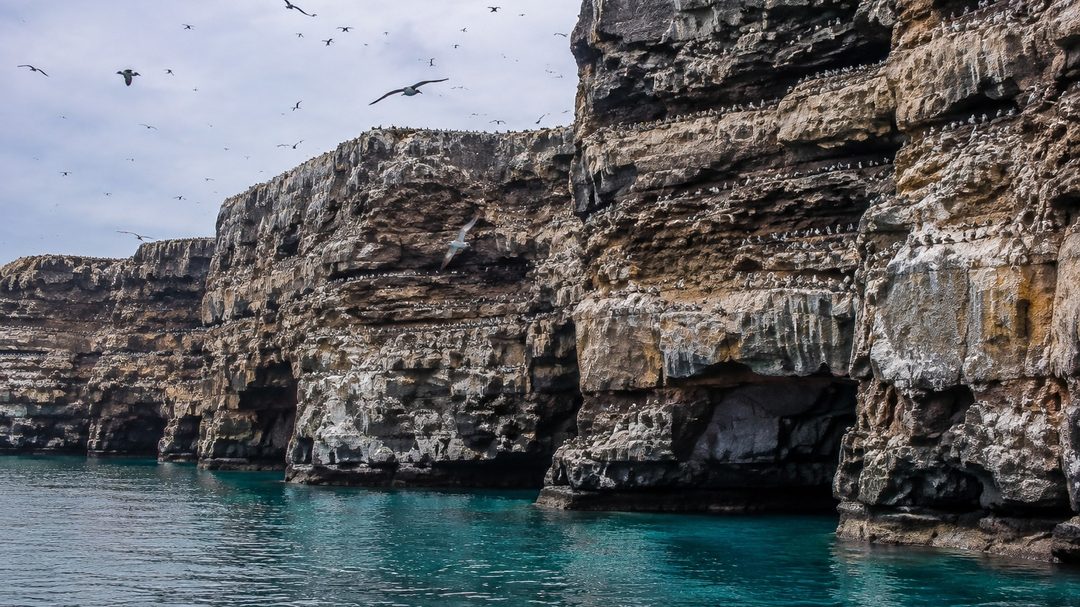
Genovesa is a drowned caldera in the far north of the archipelago — the sea broke through one wall and now fills the crater, so cruise ships anchor inside a volcano. It is called Bird Island for good reason: it holds the largest seabird colonies in the Galápagos, including most of the archipelago’s red-footed boobies, and it is the most reliable place to see a short-eared owl hunting in daylight. Cruise access only, on northern itineraries.
On this page — 8 sections
The short-eared owls on Genovesa hunt storm petrels in broad daylight, on foot, walking into the lava cracks where the petrels nest. Owls almost everywhere else are nocturnal. Here there are no daytime raptors to compete with, so they simply changed shift.
Genovesa at a glance
| Also called | Tower Island, and universally "Bird Island" |
|---|---|
| Shape | A caldera flooded by the sea — you anchor inside the crater |
| Population | None |
| Access | Cruise only, northern itineraries |
| Landing sites | Darwin Bay and Prince Philip’s Steps |
| Famous for | Red-footed boobies and the largest seabird colonies in the islands |
Getting there
This is the part that decides whether Genovesa belongs in your trip, so it goes first rather than last. How you reach the archipelago at all →
- Cruise
- Northern itineraries only. Genovesa sits well away from the central group and it costs a cruise most of a night of sailing to reach, which is why fewer boats include it.
- Day tour
- Not possible from anywhere.
- Staying over
- There is nothing to stay in.
What is on the island
- 1
A coral-sand beach inside the flooded caldera, with a short trail through mangrove and salt bush. Red-footed boobies nest in the bushes at eye level — the only booby that perches in trees — alongside frigatebirds and swallow-tailed gulls.
- 2
A steep natural staircase up a 25-metre cliff to a plateau of broken lava. Nazca boobies on the open ground, storm petrels in their thousands over the cracks, and the short-eared owls that hunt them.
- Darwin Bay
- A coral-sand beach inside the flooded caldera, with a short trail through mangrove and salt bush. Red-footed boobies nest in the bushes at eye level — the only booby that perches in trees — alongside frigatebirds and swallow-tailed gulls. What it is really like →
- Prince Philip’s Steps
- A steep natural staircase up a 25-metre cliff to a plateau of broken lava. Nazca boobies on the open ground, storm petrels in their thousands over the cracks, and the short-eared owls that hunt them. What it is really like →
Every visitor site we have written up →
The history, which is the point
Most Galápagos islands are wildlife and geology. Genovesa is those, plus two hundred years of people behaving strangely on a small piece of rock.
- FormationGenovesa is a shield volcano whose caldera flooded when one wall gave way. Great Darwin Bay is the crater; the anchorage is inside it.
- 1964Prince Philip visits during a Galápagos expedition. The natural staircase up the cliff takes his name and keeps it.
- OngoingThe island has no land reptiles of any size and no introduced predators, which is why the seabird colonies are as dense as they are.
What you see
- Red-footed booby — Most of the archipelago’s population. The only booby that perches and nests in trees, which is why you see them at eye level here.
- Nazca booby — On the open ground at the top of Prince Philip’s Steps, nesting beside the path.
- Great frigatebird — Males inflating red throat pouches in the bushes around Darwin Bay.
- Short-eared owl — Hunting storm petrels in daylight on the lava plateau. Genovesa is the most reliable place on Earth to watch this.
- Galápagos sea lion — On the beach in Darwin Bay, and in the water for the snorkel along the cliff.
Every species, with the exact sites →
Can you stay here?
No. Genovesa is uninhabited — there is no settlement, no accommodation and no landing outside the marked visitor sites. You come for a few hours and you leave. The four islands you can actually sleep on →
What we would tell you first
Fewer cruises go, and that is the point
Genovesa costs a boat most of a night of sailing each way. That keeps the numbers down and it is why the colonies feel undisturbed — but it also means you have to choose an itinerary that includes it deliberately.
Prince Philip’s Steps is a real climb
Twenty-five metres of natural rock staircase, sometimes wet. Not technical, but not for anyone unsteady on their feet.
It is birds, and mostly only birds
There are no tortoises, no land iguanas and very little else. If seabirds do not interest you, Genovesa will be a long way to go.
The other islands you visit but cannot stay on
- Española — Española: around 4 million years old, the oldest main island, and the only nesting site on Earth for the waved albatross — some 12,000 pairs. Cruise only.
- Bartolomé — The most photographed view in the Galápagos, a 114-metre boardwalk climb, and a landscape that looks like the moon. A day trip from Santa Cruz.
- Fernandina — Fernandina: under 1 million years old, still erupting, and the largest island on Earth with no introduced species established. One landing, cruise only.
- Santiago — Where Darwin spent nine days ashore, where the fur seals swim in eroded lava grottoes, and where a 130-year-old lava flow still looks a week old.
- Santa Fé — Santa Fé: around 4 million years old, and the easiest outer island to reach from Puerto Ayora. A turquoise bay of sea lions, and its own land iguana.
- North Seymour — North Seymour: a flat slab of uplifted seabed 20 minutes from the Baltra channel, with a 2 km loop past nesting blue-footed boobies and frigatebirds.
All eleven compared, side by side →
Trips that reach Genovesa
None of them quite it? Tell us what you want and we build it →
Questions people also ask
What is Genovesa Island known for?
The largest seabird colonies in the Galápagos — it is universally called Bird Island. It holds most of the archipelago’s red-footed boobies, huge frigatebird and Nazca booby colonies, and it is the most reliable place on Earth to see a short-eared owl hunting in daylight.
How do you get to Genovesa Island?
Cruise only, and only on northern itineraries. It lies well north of the central group and takes most of a night of sailing each way, which is why fewer boats include it.
What are Prince Philip’s Steps?
A steep natural rock staircase climbing about 25 metres up the cliff from the sea to a lava plateau, named after Prince Philip’s 1964 visit. At the top are Nazca boobies, thousands of storm petrels, and the owls that hunt them.
Why is Genovesa called Bird Island?
Because it has almost nothing else. There are no large land reptiles and no introduced predators, so the seabird colonies are exceptionally dense — and unusually tame, since nothing has ever hunted them from the ground.
Sources
Every figure on this page comes from one of these. If one of them changes and we have not caught up, tell us and we will fix it the same day.
- Galápagos National Park Directorate — Visitor sites, landing rules and which islets are closed to landings.
- Galápagos Conservation Trust — Independent conservation reporting, including the Floreana restoration programme.
- Ecuador Ministry of Tourism — service portal — Ecuador’s register of licensed operators — where our own licence is listed.
Planning this trip yourself?
Send us the dates and what you actually want to see. A planner in Cuenca reads it and replies within one business day — not a template, and not a bot.
Plan your trip