

Galápagos wildlife · Bird · Endemic
The flightless cormorant
Nannopterum harrisi · Phalacrocoracidae
Short answer
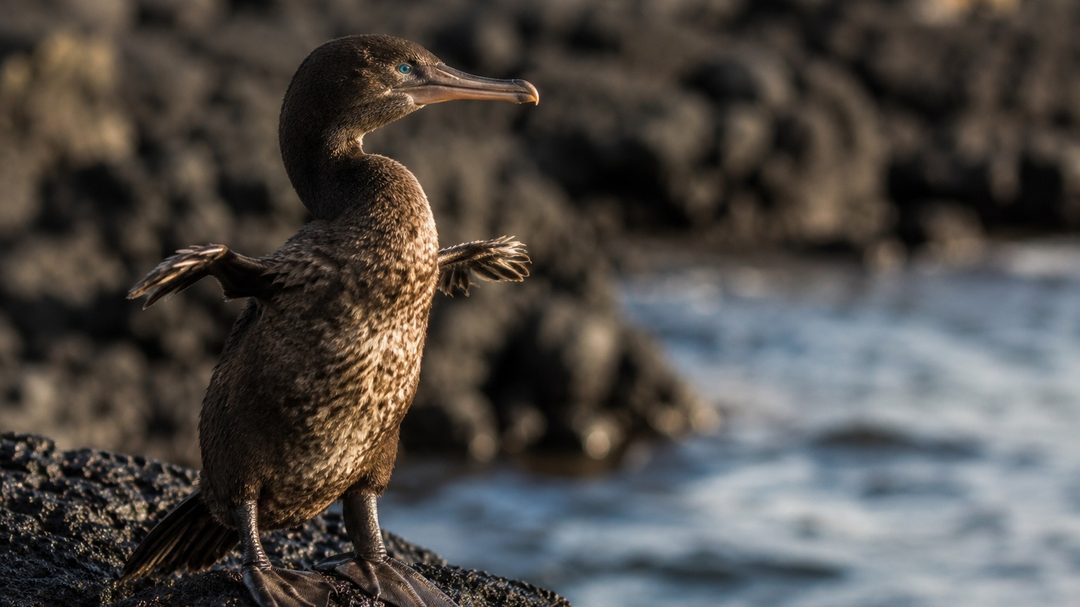
The only cormorant in the world that cannot fly. Its wings are roughly a third of the size it would need, and it lives on just two coastlines on Earth — Fernandina and the western shore of Isabela — where the cold upwelling makes the fishing so good that flying stopped being worth the cost. Around 2,000 individuals exist, which makes it one of the rarest seabirds anywhere. And it still spreads its useless wings to dry them.
Actual size
standing height.
- Height
- 90 cm
- Weight
- 2.5–4 kg
- Lifespan
- Around 13 years
It still dries its wings after every dive. Those wings have not flown for hundreds of thousands of years and cannot hold enough water to matter — the bird simply inherited the gesture and never stopped. It is the clearest piece of evolutionary leftovers you can watch happening.
Where you actually see one
This is the part a general encyclopedia cannot tell you: not where the species occurs, but which sites you can stand on, and what each one is like.
- 1
The heart of the population, and the only landing site on the island. Cruise access only.
- 2
Isabela — Punta Vicente Roca and the west coast
The other half of the world range, on the far side of Isabela. Not reachable from Puerto Villamil.
- 3
Isabela — Urbina Bay
A western cruise landing where they nest along the shore.
When to go for this one
Year-round, with breeding concentrated roughly July to October when the cold season food supply peaks. Numbers fall sharply after a strong El Niño, when warm water pushes the fish away, and take several years to recover.
The archipelago has two seasons and they are good at different things — we break both down here, month by month.
How to tell it apart
- Obvious once seen: a large dark bird with wings far too small for its body, held out to dry anyway.
- Brilliant turquoise eyes.
- A long, heavy, hooked bill.
- Thick powerful legs set far back — built for pushing underwater, useless for walking elegantly.
What it does, and why
- It dives and swims down using its feet, hunting eels, octopus and bottom-dwelling fish close to the sea floor.
- It spreads its stunted wings to dry after every dive. The wings cannot fly and barely hold water, and the behaviour persists anyway — it is inherited, not useful.
- Females often mate with several males in a season. She leaves once the chick can be fed, and the male raises it alone.
- Courtship happens in the water: the pair swim around each other with necks bent into a snake-like curve.
Why people miss it, and who it is not for
This is the part we can write and an encyclopedia cannot: what actually goes wrong when someone comes looking for this animal. It is from running these islands, not from a field guide.
You cannot get there from Puerto Villamil
This is the most common planning error we correct. Visitors stay on Isabela expecting to see the cormorant and it lives on the far western coast and on Fernandina, with no road and no boat service. It needs a western cruise, and not all of them go.
A strong El Niño empties the coast
Warm water removes the food and the population falls hard. It has recovered every time so far, but a trip planned in the wrong year sees very few.
It looks like a mistake, and that is the point
Some visitors find it faintly ridiculous and move on. It is one of the clearest pieces of visible evolution on Earth — a bird holding out wings that have not flown for hundreds of thousands of years, because the gesture was inherited and never stopped.
Conservation status
IUCN Red List: Vulnerable — around 2,000 individuals
Vulnerable, with a total population of roughly 2,000 birds confined to two coastlines. Its whole range sits inside the Galápagos Marine Reserve, and the population has been monitored closely since the 1970s. The main threats are El Niño events, which remove the food supply, and any introduced predator reaching Fernandina — which is why the biosecurity there is the strictest in the archipelago.
Questions people ask about the flightless cormorant
Why can the Galápagos cormorant not fly?
Because it did not need to. On Fernandina and western Isabela the cold upwelling makes fishing exceptionally good and there were no land predators to escape from. Flight is metabolically expensive, so over generations the wings shrank to about a third of flight size and the birds put the energy into swimming instead.
How many flightless cormorants are left?
Around 2,000 individuals, which makes it one of the rarest seabirds in the world. The entire species lives on two coastlines.
Where can you see the flightless cormorant?
Only at Punta Espinosa on Fernandina and along the west coast of Isabela. Both are cruise-only — there is no route to either from the inhabited islands.
Why does the flightless cormorant spread its wings?
To dry them, exactly as flying cormorants do — even though its wings are too small to be worth drying and it cannot fly anyway. It is inherited behaviour that outlived its purpose, and it is one of the most quoted examples of evolutionary leftovers.
What else is on the same islands
These share at least one island with the flightless cormorant. On a real day out you are likely to see several of them on the same walk.
- Galápagos giant tortoise — Isabela
- Marine iguana — Isabela, Fernandina
- Galápagos sea lion — Isabela
- Galápagos penguin — Isabela, Fernandina
- Green sea turtle — Isabela
- Red-lipped batfish — Isabela
- Galápagos land iguana — Isabela
- Galápagos fur seal — Isabela
- Sally Lightfoot crab — Isabela, Fernandina
- Blue-footed booby — Isabela
- Galápagos hawk — Fernandina, Isabela
