

Galápagos wildlife · Marine life
The red-lipped batfish
Ogcocephalus darwini · Ogcocephalidae
Short answer
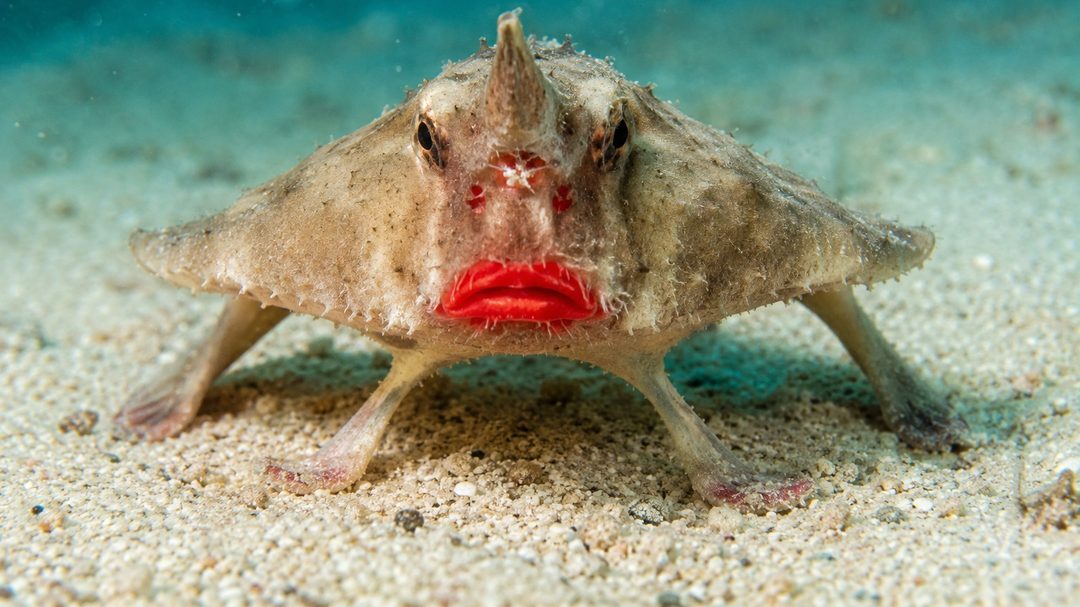
The red-lipped batfish — the fish people mean when they search for the Galápagos batfish — is the strangest-looking fish in the Galápagos and one of the strangest anywhere: a flattened, sand-coloured fish that does not swim. It walks on the sea floor on modified fins, wears what looks like bright red lipstick, and carries a small retractable lure on its snout to draw prey within reach. It is named for Darwin, it lives on sandy bottoms usually below 20 metres, and you will almost certainly need to dive rather than snorkel to see one.
Actual size
nose to tail.
- Length
- 40 cm
- Weight
- Under 1 kg
It cannot really swim. It walks on the sea floor on fins that work like legs, and if you startle it, it does a short, awkward hop and then walks again. It is one of very few fish that has essentially given up on swimming.
Where you actually see one
This is the part a general encyclopedia cannot tell you: not where the species occurs, but which sites you can stand on, and what each one is like.
- 1
Santa Cruz — Gordon Rocks and the sandy patches nearby
On the sand at depth, not on the wall. Ask the guide before the dive — they know the patches.
- 2
Santa Cruz — Cousin’s Rock
The sand at the base of the wall. Easier conditions than Gordon Rocks.
- 3
A cruise-only site on the north-west coast, and one of the better-known batfish spots.
When to go for this one
Year-round — it does not migrate and it barely moves. What changes is visibility, which is best from December to May. This is one of the few Galápagos animals where the warm season is unambiguously the better time.
The archipelago has two seasons and they are good at different things — we break both down here, month by month.
Most encounters with this one happen underwater. Which dive sites, what certification they need, and when →
How to tell it apart
- Flattened, triangular body the colour of sand, from above almost invisible until it moves.
- Bright red or orange lips, unmistakable and the reason for the name.
- A small horn on the snout, above the mouth, which conceals a retractable lure.
- Fins held like legs. It props itself up on them and walks.
What it does, and why
- A poor swimmer. It walks across the sand on its pectoral and pelvic fins rather than swimming, and only swims when alarmed.
- Ambush feeder: it extends the lure from the horn on its snout to draw small fish and crustaceans close, then takes them.
- Sits motionless for long periods, which is why divers swim over dozens without seeing one.
- Nobody has established what the red lips are for. The plausible explanations are species recognition or mate signalling; neither is proven.
Why people miss it, and who it is not for
This is the part we can write and an encyclopedia cannot: what actually goes wrong when someone comes looking for this animal. It is from running these islands, not from a field guide.
It is a dive, not a snorkel
It lives on sand below about twenty metres. People book a snorkelling trip having seen the photograph and there is no chance at all. If this is why you are coming, you need a certification.
You will swim over a dozen and see none
It is sand-coloured, flat and motionless. Divers find them because the guide knows the exact patch. Tell the guide before you get in the water, not after.
It is not the star of any dive site
Nobody plans a Galápagos dive around a batfish. It is a bonus on a dive you were doing anyway, and framing it otherwise sets up a disappointment.
Conservation status
IUCN Red List: Not formally assessed; not considered threatened
Not formally assessed by the IUCN and not considered threatened. It lives at depths that keep it away from most fishing pressure, and inside the Galápagos Marine Reserve. Its main vulnerability is the same as everything else on a sandy bottom: physical damage from anchoring and trawling, both of which are prohibited here.
Questions people ask about the red-lipped batfish
Where can you see the red-lipped batfish?
On sandy bottoms below about 20 metres — which in practice means a dive, not a snorkel. From the inhabited islands the usual sites are Gordon Rocks and Cousin’s Rock off Santa Cruz. Tell your guide before the dive; they know where the sand patches are.
Why does the red-lipped batfish have red lips?
Nobody knows for certain, and anyone who tells you otherwise is guessing. The two plausible explanations are species recognition and mate signalling. Neither has been demonstrated.
Can the red-lipped batfish swim?
Barely. It walks on the sea floor using its pectoral and pelvic fins as legs, and swims only in short, clumsy bursts when alarmed. It is one of the few fish to have largely abandoned swimming.
Is the red-lipped batfish found only in the Galápagos?
No, though it is strongly associated with them. It also occurs off the coast of Peru. Its scientific name, Ogcocephalus darwini, honours Darwin.
What else is on the same islands
These share at least one island with the red-lipped batfish. On a real day out you are likely to see several of them on the same walk.
- Galápagos giant tortoise — Santa Cruz, Isabela
- Marine iguana — Santa Cruz, Isabela
- Galápagos sea lion — Isabela
- Galápagos penguin — Isabela
- Green sea turtle — Santa Cruz, Isabela
- Galápagos shark — Santa Cruz
- Scalloped hammerhead — Santa Cruz
- Flightless cormorant — Isabela
- Galápagos land iguana — Santa Cruz, Isabela
- Galápagos fur seal — Isabela
- Sally Lightfoot crab — Santa Cruz, Isabela
- Blue-footed booby — Isabela
- Galápagos hawk — Isabela
