

Galápagos wildlife · Mammal · Endemic
The Galápagos fur seal
Arctocephalus galapagoensis · Otariidae
Short answer
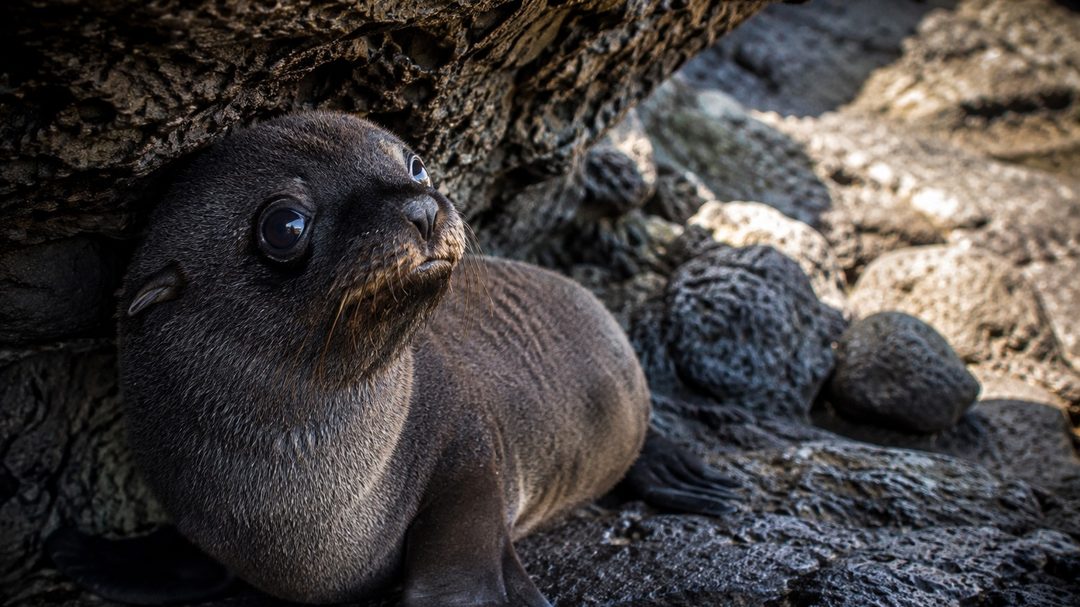
The smallest fur seal in the world, and the one visitors almost always miss — it is far less numerous than the sea lion, much shyer, and it hides from the sun. Where sea lions sprawl on open beaches, fur seals wedge themselves into shade under lava overhangs. The dense underfur that keeps them warm is also what nearly finished them: they were hunted to near-extinction for it in the nineteenth century. It is Endangered and found nowhere else.
Actual size
nose to tail, adult male.
- Length
- 1.5 m
- Weight
- to 64 kg; females around 28 kg
- Lifespan
- 20–25 years
They were declared extinct, twice. Nineteenth-century sealing was so thorough that the species was written off, and both times a small surviving colony was found later on rough coast nobody had bothered to land on.
Where you actually see one
This is the part a general encyclopedia cannot tell you: not where the species occurs, but which sites you can stand on, and what each one is like.
- 1
The grottoes and tidal pools — the most reliable place to see one, and generally cruise-only.
- 2
Along the cliff base, in shade.
- 3
Punta Vicente Roca and the cold upwelling shores. Cruise access.
When to go for this one
Year-round, and best seen in the middle of the day when they are deepest in shade and least likely to move. Pups are born roughly August to November. Numbers crash after a strong El Niño and take years to recover.
The archipelago has two seasons and they are good at different things — we break both down here, month by month.
How to tell it apart
- Smaller and stockier than a sea lion, with a shorter, blunter snout.
- Noticeably larger eyes — it feeds at night.
- A thick, dense, two-layered coat that looks almost woolly when dry.
- Longer, more prominent ear flaps than the sea lion.
- Behaviour is the fastest test: if it is asleep in the open sun on a beach, it is a sea lion. In shade under a rock, it is a fur seal.
What it does, and why
- It feeds at night, mostly on squid and fish that rise towards the surface after dark, and dives shallower than the sea lion.
- It avoids sun and heat, which is why the grottoes at Puerto Egas are the classic site — it is looking for shade, not scenery.
- Pups nurse for two to three years, far longer than a sea lion, and a female raising one will often refuse to breed again until it is done.
- Colonies are small and scattered, on rough rocky coast rather than sand.
Why people miss it, and who it is not for
This is the part we can write and an encyclopedia cannot: what actually goes wrong when someone comes looking for this animal. It is from running these islands, not from a field guide.
Most visitors walk straight past them
They are in shade, under overhangs, not sprawled in the sun. Groups scan the beach, see sea lions, and never look into the rock. If nobody points, nobody sees.
It is generally cruise-only
The reliable site is Puerto Egas on Santiago. Day trips from Santa Cruz reach Sullivan Bay, not the fur seal grottoes. People book the day trip expecting both.
They will leave if you crowd them
Unlike sea lions, they are genuinely shy. The two-metre rule matters more here because breaking it does not produce a photograph — it produces an empty rock.
Conservation status
IUCN Red List: Endangered
Endangered. Sealers took them in enormous numbers in the nineteenth century for the underfur, and the species was believed extinct more than once before small colonies were rediscovered. It has never returned to its former range. The bigger modern problem is El Niño: warm water removes the food supply and the 1982–83 and 1997–98 events each killed a large share of the population.
Questions people ask about the galápagos fur seal
What is the difference between a Galápagos fur seal and a sea lion?
The fur seal is smaller, shyer and nocturnal, with bigger eyes, a blunter snout and a thick two-layered coat. The quickest test is behaviour: sea lions sprawl in the open sun on beaches and piers; fur seals hide in shade under lava overhangs.
Where can you see fur seals in the Galápagos?
Puerto Egas on Santiago is the most reliable site — a shoreline eroded into grottoes and pools where they rest in the shade. It generally requires a cruise. They also occur on Genovesa and the western Isabela coast.
Are Galápagos fur seals rare?
Yes — Endangered, and far less numerous than the sea lion. Nineteenth-century sealing nearly finished the species and it has never recovered its former range. Strong El Niño events still kill a large share of the population.
Why are fur seals always in the shade?
Because that coat is built for cold water, not equatorial sun. They feed at night and spend the day avoiding heat, wedged into overhangs and caves. It is why most visitors walk past them.
What else is on the same islands
These share at least one island with the galápagos fur seal. On a real day out you are likely to see several of them on the same walk.
- Galápagos giant tortoise — Isabela
- Marine iguana — Isabela
- Galápagos sea lion — Isabela
- Galápagos penguin — Isabela
- Green sea turtle — Isabela
- Red-lipped batfish — Isabela
- Magnificent frigatebird — Genovesa
- Flightless cormorant — Isabela
- Galápagos land iguana — Isabela
- Sally Lightfoot crab — Isabela, Santiago
- Blue-footed booby — Isabela
- Galápagos hawk — Santiago, Isabela
