

Galápagos wildlife · Marine life
The Sally Lightfoot crab
Grapsus grapsus · Grapsidae
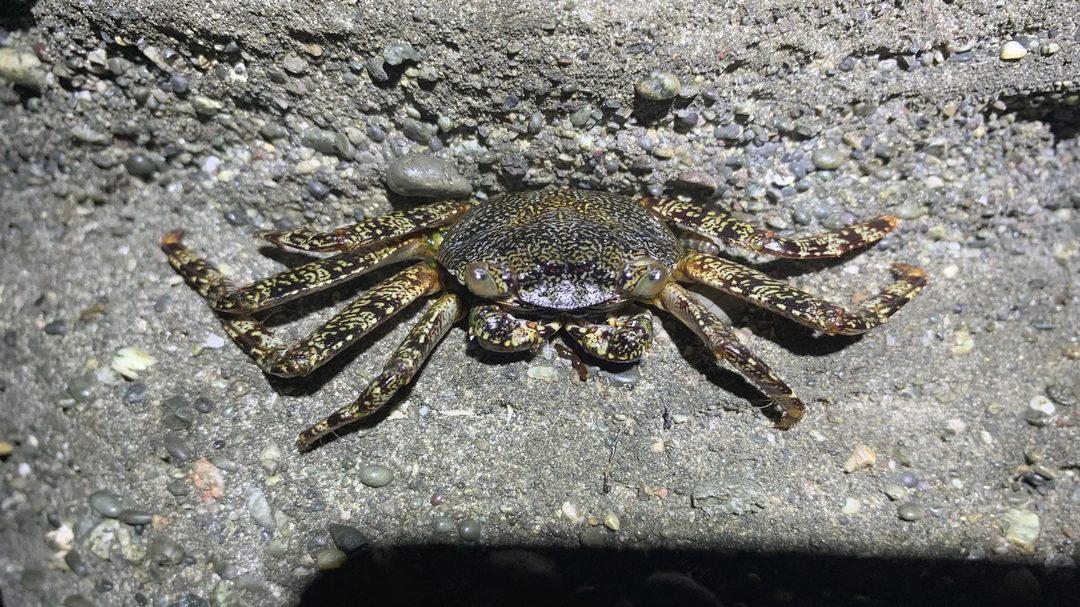
Photo: Scott Loarie · iNaturalist · CC0 1.0 · Golfito, Costa Rica — same species, not a Galápagos photograph
Short answer
The brightest thing on the black rock, and the animal in more Galápagos photographs than any other. Adults are vivid red, orange and blue; juveniles are almost black, camouflaged against the lava until they are big enough to survive being seen. They are astonishingly fast, can cross short stretches of water without sinking, and they earn their keep by picking ticks off marine iguanas.
Actual size
leg span, adult.
- Span
- 20 cm
- Weight
- Under 200 g
- Lifespan
- Estimated 10–12 years
John Steinbeck spent pages on them. In The Log from the Sea of Cortez he describes trying and repeatedly failing to catch one, and concludes that they seem able to run in any of four directions at once and to read the mind of whoever is chasing them.
Where you actually see one
This is the part a general encyclopedia cannot tell you: not where the species occurs, but which sites you can stand on, and what each one is like.
- 1
Santa Cruz — Tortuga Bay and the Puerto Ayora shoreline
On any wet black rock at the water’s edge. No boat, no guide, no fee.
- 2
Isabela — Las Tintoreras and the Villamil channels
On the lava alongside the marine iguanas they clean.
- 3
The tidal pools, in large numbers, and the best place to watch them at close range.
- 4
Scarlet against the freshest black lava in the archipelago — the strongest colour contrast anywhere here.
When to go for this one
Year-round, everywhere there is wet rock. Low tide is better than high, and early morning light on wet lava is what makes the photograph.
The archipelago has two seasons and they are good at different things — we break both down here, month by month.
Most encounters with this one happen underwater. Which dive sites, what certification they need, and when →
How to tell it apart
- Adults: red and orange carapace, often with blue and yellow underneath, and pale blue eyes.
- Juveniles: almost entirely black, and easy to walk straight past.
- Flat body and long legs, held high — it stands over the rock rather than on it.
- Movement is the giveaway. Nothing else on the shoreline moves that fast or changes direction that abruptly.
What it does, and why
- It grazes algae off wet rock, and also scavenges — it will take dead fish, bird droppings and afterbirth from sea lion colonies.
- It cleans ticks and parasites from marine iguanas, which tolerate it entirely.
- It can run across short spans of water without breaking the surface, and jump between rocks.
- The black juveniles become red only after several moults. Until then the camouflage is doing the work the speed will later do.
Why people miss it, and who it is not for
This is the part we can write and an encyclopedia cannot: what actually goes wrong when someone comes looking for this animal. It is from running these islands, not from a field guide.
Half of them are invisible and nobody mentions it
Juveniles are almost entirely black on black lava. Visitors photograph the red adults and never register that the same rock holds twice as many young ones.
It is impossible to photograph badly and impossible to approach
It is the easiest colour in the archipelago and the hardest animal to get close to. Steinbeck wrote pages about failing to catch one. Use the zoom, not your feet.
The best thing it does looks like nothing
It picks ticks off marine iguanas, and the iguana lies still and lets it. People watch it for two seconds and move on, having just seen one of the clearest cleaning relationships on Earth.
Conservation status
IUCN Red List: Not assessed; abundant
Not assessed and in no danger — it is abundant along the whole eastern Pacific coast, from Mexico to Peru, and is not endemic to the Galápagos. It matters here because it is part of the cleaning system that keeps the marine iguana colonies healthy.
Questions people ask about the sally lightfoot crab
Why are Sally Lightfoot crabs so brightly coloured?
Only the adults are. Juveniles are almost black, camouflaged against the lava, and only turn red after several moults — once they are large and fast enough that being seen no longer kills them. The adult colour is probably a warning and a signal to other crabs rather than camouflage.
Where does the name Sally Lightfoot come from?
The usual account is that it comes from a Caribbean dancer, after the way the crab moves across rock. The species itself, Grapsus grapsus, ranges along the whole eastern Pacific coast and is not unique to the Galápagos.
Do Sally Lightfoot crabs clean the marine iguanas?
Yes. They pick ticks and parasites off the iguanas, which lie still and let them. It is one of the easiest cleaning relationships in the world to watch — you will see it on any lava shoreline where both are present.
Can Sally Lightfoot crabs run on water?
Over short distances, yes. They can cross small stretches of water without sinking, jump between rocks, and change direction instantly. Steinbeck wrote about how impossible they are to catch, and he was right.
What else is on the same islands
These share at least one island with the sally lightfoot crab. On a real day out you are likely to see several of them on the same walk.
- Galápagos giant tortoise — Santa Cruz, Isabela
- Marine iguana — Santa Cruz, Isabela, Fernandina
- Galápagos sea lion — Isabela
- Galápagos penguin — Isabela, Fernandina
- Green sea turtle — Santa Cruz, Isabela
- Galápagos shark — Santa Cruz
- Scalloped hammerhead — Santa Cruz
- Red-lipped batfish — Santa Cruz, Isabela
- Flightless cormorant — Fernandina, Isabela
- Galápagos land iguana — Santa Cruz, Isabela
- Galápagos fur seal — Santiago, Isabela
- Blue-footed booby — Isabela
- Galápagos hawk — Santiago, Fernandina, Isabela
