

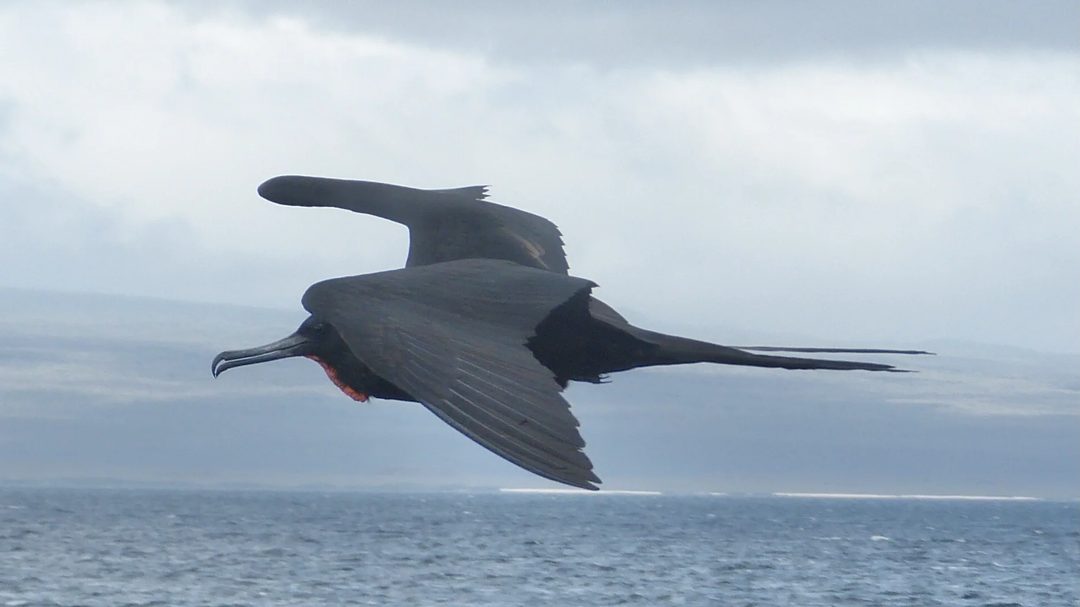
Galápagos wildlife · Bird
The magnificent frigatebird
Fregata magnificens · Fregatidae
Photo: Jean-Paul Boerekamps · iNaturalist · CC0 1.0 · North Seymour, Galápagos
Short answer
The frigatebird is a seabird that cannot land on water. Its feathers are not waterproof and its legs are almost useless, so it feeds entirely on the wing — snatching fish from the surface, or stealing them mid-air from boobies. It has the largest wing area relative to body weight of any bird, and males inflate a scarlet throat pouch to the size of a football for weeks at a time to attract a mate.
Actual size
perched height, adult male.
- Height
- 1 m
- Weight
- 1–1.6 kg — extraordinarily light for the size
- Lifespan
- Up to about 30 years
Its skeleton weighs less than its feathers. Frigatebird bones account for around five percent of body weight, the lowest of any bird, which is how a 2.3 metre wingspan flies on barely a kilogram.
Where you actually see one
This is the part a general encyclopedia cannot tell you: not where the species occurs, but which sites you can stand on, and what each one is like.
- 1
North Seymour — The nesting colony
The classic site. Males displaying in the bushes at eye level, a metre from the path.
- 2
Great frigatebirds here rather than magnificent, in enormous numbers.
- 3
San Cristóbal — Cerro Tijeretas
Named after them — tijeretas is the local name, after the scissor-shaped tail. A walk from town.
When to go for this one
Present year-round; the red-pouch display peaks roughly March to June, though some males display at other times. Outside the peak you will see plenty of frigatebirds overhead and on nests — just not the balloon.
The archipelago has two seasons and they are good at different things — we break both down here, month by month.
How to tell it apart
- Long, angular, sharply bent wings and a deeply forked tail. In silhouette nothing else looks like it.
- Males are black with a green iridescence; females have a white breast; juveniles have a white head.
- A long grey bill with a hooked tip.
- Two species occur here. The great frigatebird male has a green sheen and the magnificent a purple one — a distinction almost nobody can make in the field, and guides who claim otherwise are usually guessing.
What it does, and why
- Kleptoparasitism: it chases boobies returning with a full crop and harasses them until they disgorge the catch, then takes it in mid-air. A significant share of its diet is stolen.
- It cannot land on water. Its plumage is not waterproof and a soaked frigatebird can drown.
- It can stay airborne for days at a time and has been recorded sleeping in flight, one hemisphere of the brain at a time.
- The male inflates the gular pouch for up to twenty minutes and then holds it, sometimes for weeks, sitting in a bush and vibrating his wings at every passing female.
Why people miss it, and who it is not for
This is the part we can write and an encyclopedia cannot: what actually goes wrong when someone comes looking for this animal. It is from running these islands, not from a field guide.
The red balloon is seasonal, and brochures never say so
Males inflate the pouch mainly between March and June. Outside that window you will see plenty of frigatebirds and no red. It is the most photographed thing on North Seymour and the least guaranteed.
Two species, and nobody can reliably tell them apart
Great and magnificent frigatebirds both occur here, separated by the sheen on the male’s back — green against purple — which is invisible unless the light is right. A guide who identifies every bird instantly is guessing, and the honest ones say so.
They look enormous overhead and are almost weightless
People assume a big bird means a heavy one and expect it to land on water like a gull. It cannot. If you see one on the sea, it is in serious trouble.
Conservation status
IUCN Red List: Least Concern
Least Concern globally and common in the Galápagos. The population here is genetically distinct from mainland magnificent frigatebirds — the two have not interbred for several hundred thousand years — which some researchers argue makes the Galápagos birds a separate species. That has not been formally settled.
Questions people ask about the magnificent frigatebird
Why do frigatebirds have a red pouch?
Only the males, and only to attract a mate. He inflates the gular sac to roughly the size of a football — it takes about twenty minutes — then sits in a bush and holds it, sometimes for weeks, calling and vibrating his wings at passing females.
Can frigatebirds land on water?
No, and this is the strangest thing about them. Their feathers are not waterproof and their legs are too small to launch from the surface. A frigatebird that lands on water is in serious trouble.
Where can you see frigatebirds in the Galápagos?
North Seymour is the classic site — a twenty-minute boat ride from Santa Cruz, with males displaying in bushes right beside the path. Genovesa has vast colonies, and Cerro Tijeretas on San Cristóbal is walkable from town.
Do frigatebirds really steal food from other birds?
Yes. They chase boobies returning to the colony with full crops and harass them until they disgorge, then catch the fish in mid-air. It is called kleptoparasitism and it accounts for a real share of their diet — though they also fish for themselves.
What else is on the same islands
These share at least one island with the magnificent frigatebird. On a real day out you are likely to see several of them on the same walk.
- Galápagos giant tortoise — San Cristóbal
- Marine iguana — San Cristóbal
- Galápagos sea lion — San Cristóbal
- Green sea turtle — San Cristóbal
- Galápagos shark — San Cristóbal
- Scalloped hammerhead — San Cristóbal
- Galápagos land iguana — North Seymour
- Galápagos fur seal — Genovesa
- Blue-footed booby — North Seymour, San Cristóbal
