

Galápagos wildlife · Marine life
The Galápagos shark
Carcharhinus galapagensis · Carcharhinidae
Short answer
The Galápagos shark is a large, curious requiem shark that was first described here — which is why it carries the name, despite living around oceanic islands across the tropics. In the archipelago it is common at the rocky pinnacles and channels, and it is not a shy animal: it will approach, circle once, and lose interest. Encounters are routine at Kicker Rock and Gordon Rocks, and they are the main reason experienced divers come here rather than to the Caribbean.
Actual size
nose to tail, adult.
- Length
- 3 m
- Weight
- to 195 kg
- Lifespan
- Around 25 years
It is named after the Galápagos because that is where science first described it, not because it lives only here. It is found around isolated tropical islands worldwide — and almost never near a continental coast, which is why most people have never heard of the commonest large shark they will ever swim with.
Where you actually see one
This is the part a general encyclopedia cannot tell you: not where the species occurs, but which sites you can stand on, and what each one is like.
- 1
The channel between the two walls. Reliable, and reachable while snorkelling as well as diving.
- 2
Santa Cruz — Gordon Rocks
A submerged crater with strong current. Advanced divers only — this is not a first dive.
- 3
Occasional, usually in the deeper water outside the rim.
When to go for this one
Year-round, with more and larger animals in the cool season from June to November when the Humboldt current brings the food in. Visibility is better December to May; the sharks are more numerous June to November. You cannot have both.
The archipelago has two seasons and they are good at different things — we break both down here, month by month.
Most encounters with this one happen underwater. Which dive sites, what certification they need, and when →
How to tell it apart
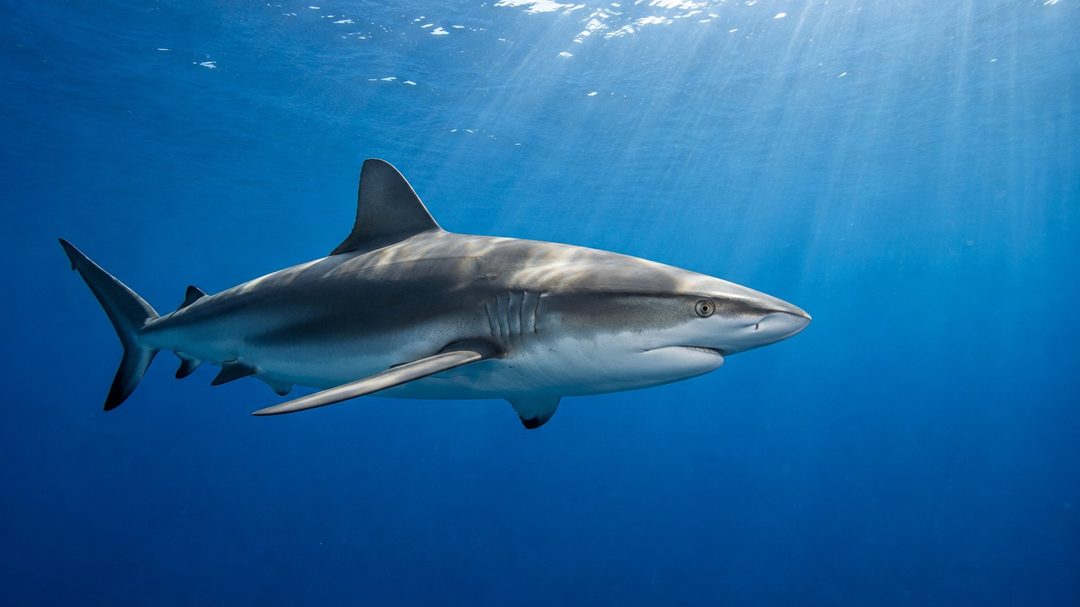
- Classic requiem shape: grey-brown above, pale below, no markings.
- The first dorsal fin is tall and rounded at the tip, and starts above the trailing edge of the pectoral fins.
- A low ridge runs along the back between the two dorsal fins — the detail that separates it from lookalikes.
- Blunt, broadly rounded snout, not pointed.
What it does, and why
- Curious rather than aggressive. The typical encounter is one slow pass at a distance of a few metres, then the animal leaves.
- Often in loose groups of several animals around a pinnacle rather than alone.
- Feeds mainly on fish and octopus, close to the bottom.
- Gives birth to live young — between four and sixteen pups, in shallow water.
Why people miss it, and who it is not for
This is the part we can write and an encyclopedia cannot: what actually goes wrong when someone comes looking for this animal. It is from running these islands, not from a field guide.
It will come towards you, and that is normal
The typical encounter is one slow, direct approach to a few metres. People who did not expect it panic, thrash, and turn a calm moment into a bad memory. The brief matters more than the certification here.
Not a guaranteed sighting, whatever the tour says
Kicker Rock is reliable, not certain. Anyone selling you a shark guarantee is selling you something they do not control.
Bad visibility changes the day completely
In the cool season there is more life and less clarity. A shark at four metres in green water is a very different experience from one at fifteen in blue, and the same site sells both.
Conservation status
IUCN Red List: Least Concern globally, but the Galápagos population is protected inside the Marine Reserve
Globally Least Concern, but that figure hides the local picture: shark populations everywhere are pressured by fishing, and the Galápagos Marine Reserve exists in large part to protect them. In 2021 Ecuador expanded the reserve by 60,000 km² to shield a migratory corridor towards Cocos Island. Illegal fishing on the reserve boundary remains a live problem.
Questions people ask about the galápagos shark
Are Galápagos sharks dangerous to humans?
They are large and confident, and they will approach you — which is startling the first time. Recorded incidents are extremely rare. Guides brief you to stay grouped, keep vertical and not chase them. Thousands of snorkellers pass through the Kicker Rock channel with them every year.
Where can you see Galápagos sharks?
The most reliable places are Kicker Rock off San Cristóbal — where you can meet them while snorkelling, not just diving — and Gordon Rocks off Santa Cruz, which is an advanced dive with real current.
How big do Galápagos sharks get?
Commonly two to three metres. The largest recorded reach about 3.7 m, which is a little longer than two adults lying end to end.
Can you snorkel with sharks in the Galápagos?
Yes, and it is one of the few places where it happens routinely rather than as an organised attraction. There is no cage, no bait and no feeding — you are simply in water they also use.
What else is on the same islands
These share at least one island with the galápagos shark. On a real day out you are likely to see several of them on the same walk.
- Galápagos giant tortoise — Santa Cruz, San Cristóbal
- Marine iguana — Santa Cruz, San Cristóbal
- Galápagos sea lion — San Cristóbal
- Green sea turtle — Santa Cruz, San Cristóbal
- Scalloped hammerhead — San Cristóbal, Santa Cruz
- Red-lipped batfish — Santa Cruz
- Magnificent frigatebird — San Cristóbal
- Galápagos land iguana — Santa Cruz
- Sally Lightfoot crab — Santa Cruz
- Blue-footed booby — San Cristóbal
