

Galápagos wildlife · Marine life
The scalloped hammerhead
Sphyrna lewini · Sphyrnidae
Short answer
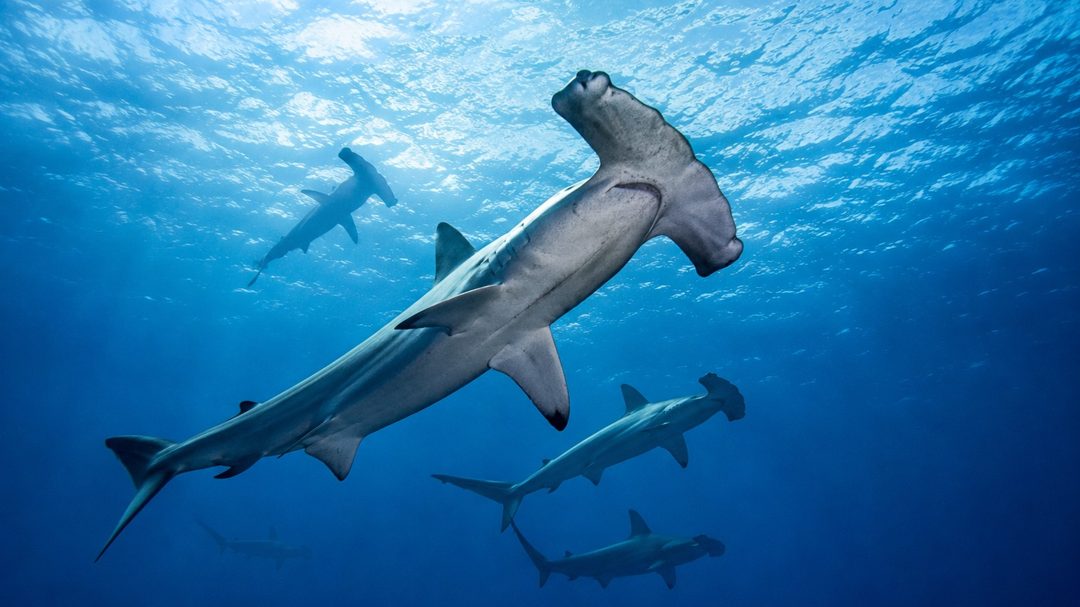
The scalloped hammerhead is the animal most divers come to the Galápagos for. It forms schools of dozens to hundreds around the northern seamounts, and smaller groups at the pinnacles reachable from the inhabited islands. It is also Critically Endangered: the global population has fallen catastrophically through finning and bycatch, which makes the Galápagos schools one of the last places on Earth where you can still see the species behaving normally.
Actual size
nose to tail, adult female.
- Length
- 3.2 m
- Weight
- to 150 kg
- Lifespan
- Around 30 years
They school by day and hunt alone at night, which is backwards for a shark. Nobody is certain why. The leading explanation is that the schools are about mate selection rather than feeding — the largest females hold the centre.
Where you actually see one
This is the part a general encyclopedia cannot tell you: not where the species occurs, but which sites you can stand on, and what each one is like.
- 1
Groups in the channel, most reliably in the cool season. The only site on this list you can reach while snorkelling.
- 2
Santa Cruz — Gordon Rocks
The classic day-trip hammerhead dive from Puerto Ayora. Strong current, advanced certification required.
- 3
Santa Cruz — Cousin’s Rock
Smaller numbers, but easier conditions and excellent for everything else on the wall.
When to go for this one
June to November, without much argument. The cool season brings the Humboldt current, the water drops to around 20 °C and the schools form. December to May the water is warmer and clearer but the numbers fall away. Bring a wetsuit and accept the trade.
The archipelago has two seasons and they are good at different things — we break both down here, month by month.
Most encounters with this one happen underwater. Which dive sites, what certification they need, and when →
How to tell it apart
- The head is the giveaway — flattened into a wide bar with the eyes at the tips.
- “Scalloped” refers to the notched front edge of that bar, which distinguishes it from the smooth and great hammerheads.
- Bronze-grey above, white below.
- In schools they cruise slowly in loose formation, usually well below the surface.
What it does, and why
- Schools by day around seamounts and pinnacles, then disperses to hunt alone at night — the opposite of most sharks.
- The wide head is packed with electroreceptors: it works as a scanner, sweeping the sea floor for buried prey.
- The wide-set eyes give it close to 360-degree vertical vision.
- Nervous of bubbles. Divers who exhale slowly and stay still see far more than those who swim at them.
Why people miss it, and who it is not for
This is the part we can write and an encyclopedia cannot: what actually goes wrong when someone comes looking for this animal. It is from running these islands, not from a field guide.
Gordon Rocks is where people find out they were not ready
It is an advanced dive with real current and a negative entry. Divers who logged twenty dives in a warm calm sea five years ago should not start here, and the good operators will refuse them. Being refused at the boat costs you the day and the money.
Bubbles push them away
They are shy of exhaust. Divers who swim at the school see it dissolve. The ones who hang still on the reef, breathing slowly, get the twenty minutes.
The famous walls are not reachable from the islands
Darwin and Wolf require a liveaboard of seven or eight nights. Every year people book a land-based trip expecting those numbers and get a handful of animals at Gordon Rocks instead.
Conservation status
IUCN Red List: Critically Endangered — the global population has collapsed
Critically Endangered on the IUCN Red List. The species is targeted for its fins and taken in enormous numbers as bycatch, and populations have fallen by an estimated 80% or more in parts of its range. The Galápagos Marine Reserve, and the migratory corridor towards Cocos Island protected since 2021, is one of the few places where schools of this size still occur.
Questions people ask about the scalloped hammerhead
Where can you see hammerhead sharks in the Galápagos?
The famous schools are at Darwin and Wolf in the far north, which are reachable only on a liveaboard dive cruise. From the inhabited islands the two reliable sites are Gordon Rocks off Santa Cruz and Kicker Rock off San Cristóbal — and Kicker Rock is the only one where snorkellers see them.
What is the best time to see hammerheads in the Galápagos?
June to November, the cool season. The Humboldt current arrives, the water drops to about 20 °C, and the schools form. It is also the choppiest time of year — that is the trade.
Do you need to be a certified diver to see hammerheads?
For Gordon Rocks, yes, and an advanced certification with current experience — it is not a beginner dive. At Kicker Rock confident snorkellers do see them, in the channel between the two walls.
Are hammerhead sharks dangerous?
Scalloped hammerheads are shy of divers and of bubbles. The usual problem is not getting close enough. Attacks on humans are exceptionally rare.
What else is on the same islands
These share at least one island with the scalloped hammerhead. On a real day out you are likely to see several of them on the same walk.
- Galápagos giant tortoise — Santa Cruz, San Cristóbal
- Marine iguana — Santa Cruz, San Cristóbal
- Galápagos sea lion — San Cristóbal
- Green sea turtle — Santa Cruz, San Cristóbal
- Galápagos shark — San Cristóbal, Santa Cruz
- Red-lipped batfish — Santa Cruz
- Magnificent frigatebird — San Cristóbal
- Galápagos land iguana — Santa Cruz
- Sally Lightfoot crab — Santa Cruz
- Blue-footed booby — San Cristóbal
